
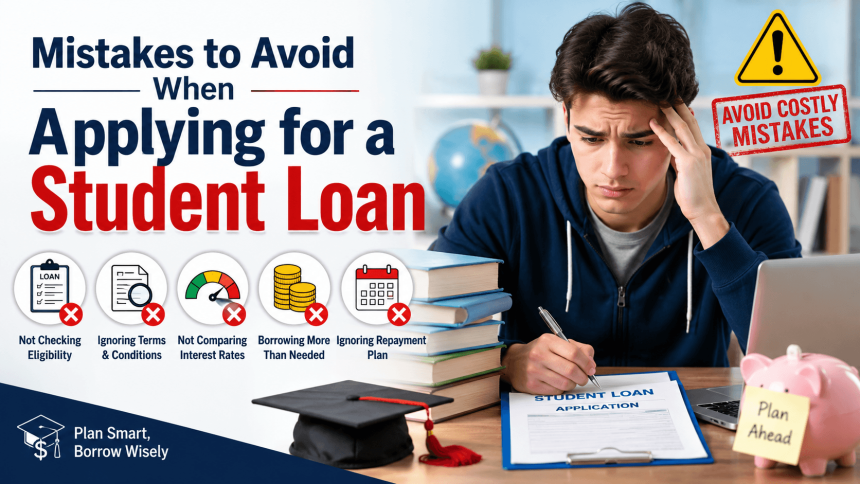
Mistakes to Avoid When Applying for a Student Loan. Higher education can open the door to better career opportunities, improved job prospects, and greater earning potential. However, studying at a university, college, or other tertiary institution can be expensive. Tuition fees, accommodation, books, equipment, and other education-related expenses can quickly become difficult for students and their families to manage.
For students who need financial assistance, a student loan can provide the funding required to continue and complete their studies. These loans are generally designed to help cover eligible education-related expenses, but taking on this type of financial commitment should not be done without careful consideration.
Before applying, students should understand how the loan works and avoid common mistakes that could create financial difficulties later.

1. Not Researching Your Student Loan Options
One of the biggest mistakes students can make is accepting the first student loan they find without comparing their options.

Several financial institutions in South Africa offer student loans, and their interest rates, repayment requirements, fees, and eligibility criteria can differ. Before choosing a lender, carefully compare the available options and select a loan that fits your financial circumstances.
Pay particular attention to:
- The interest rate
- When repayments must begin
- The repayment period
- Whether a surety or co-signer is required
- Additional fees and charges
- Whether existing student debt can be included

Taking time to compare loans can help you make a more informed financial decision.
2. Applying Without the Required Documents
Another common mistake is submitting a student loan application without having all the necessary documents ready.
Missing documentation can delay the application process and, in some cases, may result in the application being declined. Requirements vary between lenders, so applicants should check exactly what is needed before submitting their applications.
Documents may include identification documents, recent bank statements, proof of income, proof of registration at an educational institution, and information showing how much funding is required.

Preparing your documents in advance can make the application process smoother and reduce unnecessary delays.
3. Borrowing More Money Than You Need
A student loan should generally be used to cover essential education-related expenses rather than provide additional spending money.
Students may need funding for tuition, accommodation, textbooks, educational equipment, and other necessary study costs. However, borrowing more than necessary can create a larger debt that must eventually be repaid with interest.
The more money you borrow, the greater your potential repayments may become. Therefore, calculate your education expenses carefully and apply only for the amount you genuinely need.
4. Choosing the Longest Repayment Period
A repayment plan with smaller monthly instalments may initially seem attractive because it leaves more money available in your monthly budget.
However, choosing a longer repayment period can mean paying interest for a longer time. As a result, the total amount repaid over the life of the loan could be significantly higher.
Instead of automatically choosing the smallest monthly payment, consider the overall cost of the loan. Choose a repayment schedule that provides manageable monthly payments while avoiding an unnecessarily long repayment period.
5. Not Reading the Loan Terms and Conditions
Before signing a student loan agreement, applicants should carefully read and understand its terms and conditions.
One important concept to understand is the principal debtor. This refers to the person who is primarily responsible for ensuring that the debt is repaid.
Students are often responsible for repaying their student loans. However, some student loans may require a surety or co-signer. Depending on the agreement, the surety may be responsible for certain interest, fees, or repayments while the student is studying and could become responsible for the debt if the student cannot make the required payments.
Understanding these responsibilities before signing the agreement can help prevent misunderstandings later.
6. Ignoring the Impact on Your Credit Record
A student loan can affect your credit profile depending on how you manage the repayments.
Making repayments on time can demonstrate responsible borrowing behaviour, while missing payments or defaulting on the loan can negatively affect your credit rating. A damaged credit record may make it more difficult to obtain credit in the future.
For this reason, students should treat their repayment obligations seriously and keep track of their payment dates.
What to Do If You Cannot Make Your Repayments
Financial circumstances can change, particularly after graduation when a student is looking for employment or starting a new career.
If you realise that you cannot afford an upcoming student loan repayment, do not simply ignore the problem. Contact your lender as soon as possible and explain your circumstances. The lender may be able to discuss available options depending on the terms of your agreement.
Communicating early can be better than allowing missed payments to accumulate without explanation.
Conclusion
Applying for a student loan is an important financial decision that can help students afford higher education, but it also creates a repayment obligation that can continue after graduation.
Students should research different loan options, prepare the required documentation, borrow only what they need, carefully compare repayment plans, and fully understand the loan agreement before signing it. They should also keep up with repayments and communicate with their lender if financial difficulties arise.