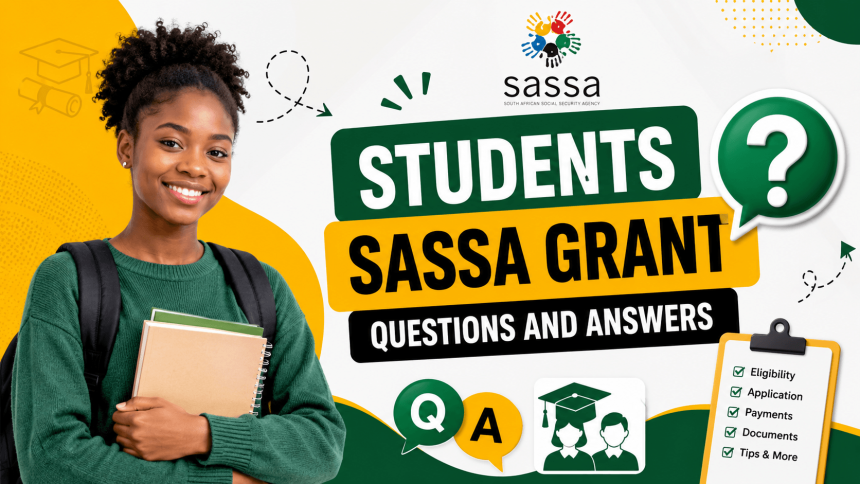
SASSA Grant Questions and Answers. The South African Social Security Agency (SASSA) provides financial assistance through social grants to eligible people who are experiencing financial hardship. For many disadvantaged students, the Social Relief of Distress (SRD) Grant can provide important support while they pursue their tertiary education.
Students often have questions about whether receiving a SASSA grant can affect their eligibility for bursaries, NSFAS funding, student loans, or their university enrollment. Below are answers to some of the most common questions students may have.
Can SASSA Grant Recipients Receive NSFAS Funding?
Yes, receiving a SASSA grant does not automatically prevent a student from applying for NSFAS funding. However, being a SASSA grant recipient does not guarantee that the student will receive an NSFAS bursary.

Students must still meet the relevant NSFAS eligibility requirements and complete the application process correctly. NSFAS will assess applications according to its applicable criteria.
Can SASSA Grant Recipients Receive Bursaries?

Yes. Students who receive a SASSA grant may also qualify for bursaries. Many bursary programmes are designed to assist students from financially disadvantaged backgrounds, so receiving a social grant may demonstrate that a student requires financial assistance.
When applying for a bursary, students should provide accurate information about their financial circumstances. If requested, they may need to submit proof of their SASSA grant, such as an official grant letter or other relevant SASSA documentation.
However, financial need is generally only one part of a bursary’s eligibility requirements. Students should carefully check the academic, financial, citizenship, institutional, or other conditions attached to each bursary before applying.
Can SASSA Grant Recipients Receive Student Loans?
A student receiving a SASSA SRD Grant may be able to apply for a student loan, but the answer depends on the specific lender and loan programme.
Some student loan providers may consider a student’s income or financial circumstances when assessing an application. In some cases, a social grant could therefore be taken into account.
Before applying, students should contact the loan provider or their educational institution and ask whether receiving an SRD Grant affects eligibility. They should also review the loan’s repayment terms, interest charges, and other conditions before accepting funding.

Will Receiving a SASSA SRD Grant Affect Academic Progress or Enrollment?
Receiving a SASSA SRD Grant should not, by itself, prevent an eligible student from continuing their studies or maintaining their enrollment.
However, students should make sure that they have sufficient financial support for important education-related expenses, including tuition where applicable, transportation, study materials, accommodation, and other costs.
Students should also continue meeting their institution’s academic and enrollment requirements.
Should Students Declare Their SASSA Grant When Applying for Financial Aid?
Yes. Students should provide complete and accurate information when applying for bursaries, financial aid, or student loans.
If an application asks about social grants or other sources of financial support, students should declare their SASSA grant rather than leaving out the information. Providing incorrect or incomplete information could lead to an application being rejected or funding being withdrawn if the information is discovered later.
Being honest about receiving a SASSA grant allows the funding organisation to assess the student’s financial circumstances correctly.
What Documents May Students Need?
The exact documents depend on the bursary, loan, or financial-aid programme. Students may be asked to provide documents such as:
- Proof of SASSA grant receipt
- A SASSA grant letter or relevant statement
- Identification documents
- Proof of registration or admission
- Academic records
- Proof of household income or financial circumstances
- Other documents specified by the funding provider
Students should always check the official requirements before submitting an application.
Conclusion
SASSA grant recipients who are studying at tertiary institutions may still have access to other forms of financial assistance. Receiving a grant does not automatically mean that a student will be excluded from NSFAS, bursaries, or student loans. However, every funding programme has its own eligibility rules.
Students should carefully review the requirements of each opportunity, provide accurate information about their SASSA grant, and submit all requested supporting documents. When there is uncertainty about whether a grant affects eligibility, contacting the relevant bursary provider, NSFAS, institution, or loan provider is the safest way to obtain an accurate answer.