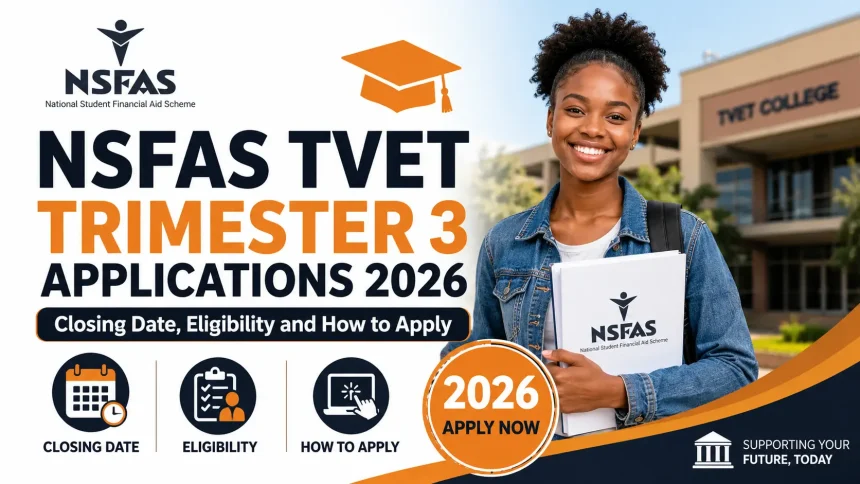
NSFAS TVET Trimester 3 Applications 2026. The National Student Financial Aid Scheme (NSFAS) has issued an important reminder to students interested in financial assistance for Technical and Vocational Education and Training (TVET) studies. Applications for the NSFAS TVET Trimester 3 funding cycle are closing on 23 August 2026, meaning prospective applicants have less than a week to complete and submit their applications.
NSFAS is encouraging eligible students not to delay their applications. Students who want to receive funding for the third trimester should make sure that their information and supporting documents are submitted correctly before the closing date.
NSFAS TVET Trimester 3 Applications Closing Soon
NSFAS has been counting down to the application deadline for TVET Trimester 3 funding. With the closing date set for 23 August 2026, students who have not yet applied are encouraged to complete the process as soon as possible.

The application process is designed to be completed online through the official NSFAS platform. Applicants should carefully check their information before submitting because missing or incorrect details can delay the assessment of an application.

NSFAS provides financial assistance through both its bursary and student loan programmes, depending on the applicant’s household income and other eligibility requirements.
How to Apply for NSFAS TVET Trimester 3 Funding
Applying for NSFAS funding involves several straightforward steps. Students should use the official NSFAS website and complete the application through their myNSFAS profile.

The main steps include:
- Visit the official NSFAS website.
- Create or access your myNSFAS profile.
- Complete all required personal, academic and financial information.
- Submit the application before the 23 August 2026 deadline.
Applicants should ensure that all required supporting documents are uploaded where necessary. After submitting the application, students should regularly check their myNSFAS account for updates.
NSFAS Application Status Explained
Once an application has been submitted, NSFAS will assess the information provided by the student. The application status can change as it moves through different stages of the assessment process.
An “Application Submitted” status generally means that the application has been received and is awaiting further processing. It may later change to “Under Review”, indicating that NSFAS is assessing the applicant’s eligibility.

Students may also receive a “Documents Missing” status. This means that additional documentation is required before the application can continue. Applicants with missing documents should log into their myNSFAS profile and upload the requested files as soon as possible.
After the assessment process is completed, NSFAS will communicate an approval or rejection decision. If an application is rejected, the student should check the provided reason and follow any available appeal or correction process where applicable.
NSFAS Bursary Eligibility
The NSFAS bursary is available to qualifying South African citizens and permanent residents who meet the scheme’s financial and academic requirements.
According to the information provided, applicants generally qualify for the bursary where their combined household income is not more than R350,000 per year. For persons living with disabilities, the household income threshold is R600,000 per year.
Students receiving SASSA grants may automatically meet the financial eligibility requirement, subject to NSFAS’s other rules and verification processes.
Because funding requirements can change, applicants should always review the latest information provided through the official NSFAS platform before submitting their applications.
NSFAS Student Loan Eligibility
NSFAS also provides a student loan option for eligible applicants whose household income falls above the bursary threshold.
The NSFAS student loan is aimed at South African citizens and permanent residents with a combined household income of approximately R350,001 to R600,000 per year. For applicants living with disabilities, the applicable household income limit is also stated as R600,000.
Students should carefully determine which funding option applies to their circumstances before completing the application.
Who May Not Qualify for NSFAS Funding?
Although NSFAS provides financial support to many students, certain applicants may be excluded from funding. The scheme identifies several circumstances that can make a student ineligible.
These include students who have already received 100% study funding from non-NSFAS sources. A student who has already obtained an undergraduate qualification and wants to pursue another undergraduate qualification may also be excluded.
Similarly, students who have completed a certificate qualification and want to study for a second certificate qualification may not qualify under the stated conditions.
Students enrolled at private institutions are also listed among those who are not eligible for NSFAS funding. In addition, qualifications that have not been approved by the Department of Higher Education and Training (DHET) and/or are not appropriately accredited through the South African Qualifications Authority (SAQA) may not qualify for funding.
Important Deadline for TVET Students
The most important date for students planning to apply for NSFAS TVET Trimester 3 funding is 23 August 2026. Since the deadline is approaching quickly, applicants should avoid waiting until the final day.
Before submitting an application, students should check their personal details, household information, academic information and supporting documents. They should also keep their login details secure so they can continue monitoring their application status.
Conclusion
The NSFAS TVET Trimester 3 application window is nearing its end, with applications scheduled to close on 23 August 2026. Eligible students who require financial assistance should complete their applications as soon as possible through the official NSFAS platform.
The process requires applicants to create a myNSFAS profile, provide the requested information, upload necessary documents and submit the application. After submission, students should monitor their application status and respond quickly if NSFAS requests additional documents.