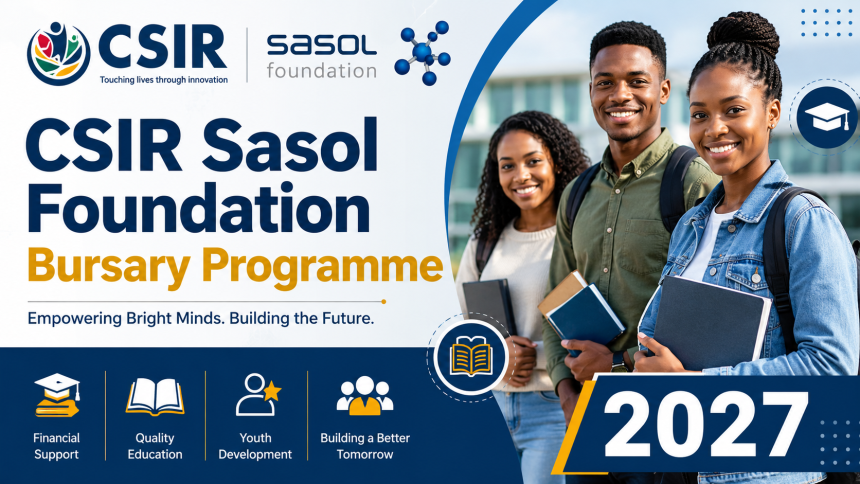
CSIR Sasol Foundation Bursary Programme. Applications are now open for the CSIR-Sasol Foundation Bursary Programme 2027, offering an excellent opportunity for academically deserving South African students who want to pursue careers in science, engineering and technology.
The bursary programme is offered by the Council for Scientific and Industrial Research (CSIR) in partnership with the Sasol Foundation. It is designed to provide financial support to full-time, unemployed students studying in selected priority fields that are aligned with South Africa’s science, engineering and technology needs.
The programme aims to help talented young people access higher education while contributing to the development of skills required for research, innovation and technological advancement.

CSIR Sasol Foundation Bursary 2027
The CSIR-Sasol Foundation Bursary is intended for students who demonstrate strong academic potential and want to pursue approved STEM qualifications at South African public universities.

The application closing date is 15 September 2026 at 12:00. Students who meet the eligibility requirements are encouraged to submit their applications before the deadline.
| Bursary Detail | Information |
|---|---|
| Bursary Programme | CSIR-Sasol Foundation Bursary Programme |
| Academic Year | 2027 |
| Organisations | CSIR and Sasol Foundation |
| Target Students | Academically deserving South African youth |
| Study Level | Undergraduate |
| Study Type | Full-time |
| Institution | South African public university |
| Closing Date | 15 September 2026 |
| Focus Areas | Science, Engineering and Technology |
Who Can Apply for the Bursary?
The programme is aimed at academically deserving South African youth who want to study in priority STEM fields.

The bursary places particular emphasis on empowering women, black students and people with disabilities. This focus is intended to encourage greater participation and representation in science, technology and engineering-related fields.
Applicants should be South African citizens and must meet the relevant academic requirements for their category.
The programme is intended for full-time, unemployed students, meaning applicants should be focused on their studies and meet the conditions specified by the bursary providers.
Fields of Study Supported
The CSIR-Sasol Foundation Bursary supports selected undergraduate qualifications in science, engineering and technology.

The listed fields of study include:
- Aeronautical Engineering
- Mechatronic Engineering
- Mechanical Engineering
- Computer Engineering
- Electronic Engineering
- Computer Science
- Chemical Engineering
Students interested in applying should make sure that their intended qualification falls within the supported fields before submitting an application.
These study areas are closely connected to technological development, engineering innovation, digital transformation and scientific research.
Requirements for Current Grade 12 Learners
Current Grade 12 learners can apply if they meet the academic and citizenship requirements.
Applicants must:
- Be a South African citizen.
- Intend to study full-time at a South African public university.
- Meet the specified minimum subject marks.
The minimum subject requirements include:
- English: Level 5
- Mathematics: Level 6
- Physical Science: Level 6
These requirements demonstrate the strong academic standard expected from prospective bursary recipients.
Students should carefully check their latest academic results and ensure that they meet the minimum requirements before applying.
Requirements for Current University Students
The programme is also available to qualifying students who are already enrolled at university.
Current university students must:
- Be a South African citizen.
- Plan to register for full-time study at a South African university.
- Have passed all current university courses to date.
Applicants already studying at university should ensure that their academic record meets the required standard.
The bursary is aimed at students who demonstrate academic commitment and have the potential to succeed in their selected STEM qualification.
What Does the CSIR Sasol Bursary Cover?
One of the major advantages of this programme is that it is described as a full-cost bursary.
Successful applicants can receive financial support for several important study-related expenses.
The bursary covers:
Registration and Tuition Fees
The programme provides funding for university registration and tuition fees, reducing the direct cost of higher education for successful beneficiaries.
Prescribed Textbooks
Students can receive support for prescribed learning materials and textbooks required for their academic programmes.
Accommodation
The bursary includes accommodation support, helping eligible students manage one of the largest costs associated with studying away from home.
Living Allowance
A living allowance is also included to assist students with everyday expenses while they complete their studies.
Laptop Allowance
Successful beneficiaries may receive a once-off laptop allowance, providing valuable support for students who need access to technology for assignments, research, online learning and academic work.
Additional Support for Bursary Recipients
The CSIR-Sasol Foundation Bursary Programme goes beyond direct financial assistance.
Successful students can receive non-financial wrap-around support services designed to help them navigate their academic journey.
Another benefit is the opportunity for vacation work. Practical workplace exposure can allow students to gain valuable experience while learning how their academic knowledge can be applied in professional environments.
Vacation work can also help students develop communication, teamwork, technical and problem-solving skills.
Bursary Work-Back Requirement
Applicants should be aware that the bursary comes with an important condition.
Successful recipients are required to work back one year for every year of funding received through the CSIR and Sasol Foundation.
This means students accepting the bursary should understand the work-back obligation before agreeing to the funding.
Applicants should carefully review the official bursary terms and conditions to understand how this requirement will apply to their individual circumstances.
Why This Bursary Matters
The CSIR-Sasol Foundation Bursary Programme can provide an important pathway for talented young South Africans who want to build careers in STEM fields.
Engineering, computer science and other technology-related disciplines require strong technical skills and can contribute significantly to innovation and economic development.
By supporting students financially and providing additional opportunities such as vacation work, the programme aims to help beneficiaries develop both academic knowledge and practical experience.
How to Apply
Students interested in the CSIR Sasol Foundation Bursary Programme 2027 should review all eligibility criteria before submitting an application.
Applicants should make sure that their academic information, citizenship details and intended field of study meet the programme requirements. Current university students should also ensure that they have passed all courses completed to date.
The application deadline is 15 September 2026 at 12:00. Candidates should submit their applications before the closing time and avoid leaving the process until the final day.
Conclusion
The CSIR-Sasol Foundation Bursary Programme 2027 offers comprehensive financial and developmental support to South African students pursuing selected qualifications in science, engineering and technology.
With coverage for tuition, registration, textbooks, accommodation, living expenses and a once-off laptop allowance, the programme can significantly reduce the financial challenges associated with university study.
Students who meet the academic requirements and are interested in fields such as Computer Science, Mechanical Engineering, Chemical Engineering, Mechatronic Engineering, Electronic Engineering, Computer Engineering or Aeronautical Engineering should consider applying.