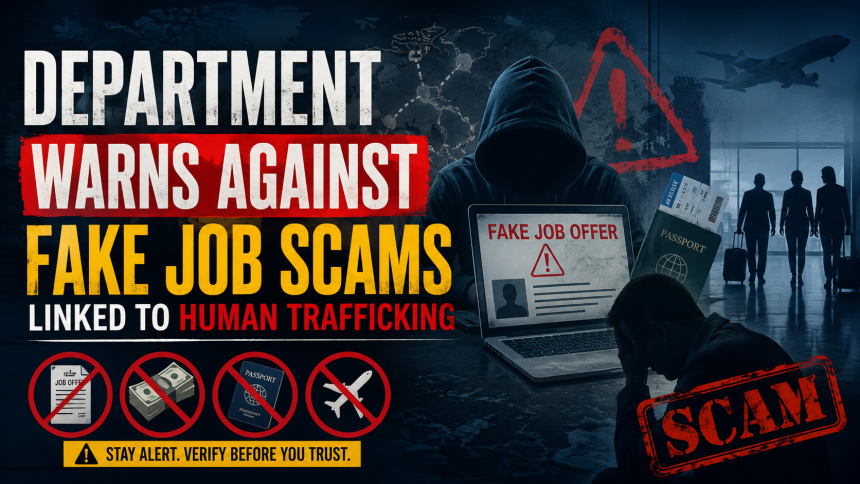
Against Fake Job Scams Linked to Human Trafficking. The Department of Social Development (DSD) has issued an important warning to South Africans about the growing threat of fake online job scams linked to human trafficking. Young people looking for employment, particularly overseas opportunities, are being urged to remain cautious when responding to job advertisements shared through social media and other online platforms.
The warning comes as the world observes World Day Against Trafficking in Persons, which takes place annually on 30 July. The global theme, “Trapped Behind the Scam,” focuses on how organised criminal networks are increasingly using fraudulent job advertisements to target potential victims.
Fake Overseas Jobs Used to Recruit Victims
According to the Department of Social Development, human trafficking syndicates are using attractive employment offers to convince people to travel overseas. These advertisements may promise high salaries, free accommodation, free flights, and other benefits that can appear difficult to refuse, particularly to young people who are actively searching for work.

However, what initially looks like a genuine employment opportunity can turn into a dangerous trafficking situation.

DSD Trafficking in Persons Manager Buti Kulwane said an increasing number of young South Africans have reportedly become victims after accepting job offers that appeared to be legitimate. Some of these opportunities were linked to employment in Thailand.
After travelling to the region, victims were allegedly transported across the Thailand-Myanmar border and forced to work in scam compounds. Instead of performing the jobs they had been promised, victims were reportedly compelled to participate in cyber-enabled financial crimes.
Victims Face Abusive Working Conditions

The department said trafficking victims can experience extremely difficult conditions once they are under the control of criminal networks.
Victims may be forced to work for long hours while facing intimidation, threats, violence and other forms of abuse. Some may also be placed under debt bondage, making it difficult or dangerous for them to leave.
Traffickers can initially create the impression that victims are travelling to a foreign country for a well-paid job. Once victims reach their destination, however, their passports or freedom of movement may be restricted, leaving them dependent on the trafficking network.
The department has also highlighted another disturbing tactic used by some trafficking syndicates. Victims may be pressured or forced to recruit their own friends, relatives and other people into the same schemes. This allows criminal organisations to find additional victims through existing personal relationships.

South African Victims Rescued and Repatriated
Several groups of South African trafficking victims have reportedly been rescued and returned to the country since 2024.
These operations have involved cooperation between multiple government departments, law enforcement agencies and civil society organisations. The organisations involved include the Department of International Relations and Cooperation (DIRCO), South African Police Service (SAPS), Directorate for Priority Crime Investigation (DPCI), Border Management Authority, Department of Home Affairs, and civil society groups.
Coordinated intervention is important because trafficking cases can involve international travel, organised crime, immigration issues and the protection of vulnerable individuals.
Support Available for Survivors
Returning home is not necessarily the end of the difficulties faced by trafficking survivors. People who have experienced exploitation may require significant assistance as they rebuild their lives.
The Department of Social Development said survivors can receive support that may include psychosocial assistance, family reunification and reintegration services.
These services are intended to help survivors reconnect with their families and communities while receiving the support they need following traumatic experiences.
How to Identify a Fake Job Offer
Job seekers should take several precautions before accepting an overseas employment opportunity. A job advertisement should not automatically be considered genuine simply because it appears professional or offers an attractive salary.
Some warning signs may include:
- Promises of unusually high salaries for basic work
- Offers of free international travel without proper documentation
- Pressure to make a quick decision
- Requests for money before employment begins
- Recruitment through unknown social media accounts
- Lack of a verifiable employer
- No formal employment contract
- Unclear job responsibilities
- Requests to travel through unusual routes
- Recruiters who avoid providing company details
Job seekers should independently verify the employer rather than relying only on information supplied by the recruiter.
Verify Overseas Employment Opportunities
The Department of Social Development is encouraging young South Africans to conduct proper research before accepting overseas job offers.
Potential employees should research the company, recruitment agency and location where they are expected to work. They should also discuss the opportunity with trusted family members or other people who can help identify potential risks.
People should be particularly careful with job offers found through social media. While legitimate employers do advertise online, social media platforms can also be used by criminals to reach large numbers of potential victims.
Applicants should verify company contact details independently and avoid sending sensitive personal documents or money to suspicious recruiters.
Parents and Communities Can Help
The department is also encouraging parents, caregivers, educators and community members to talk openly with young people about online recruitment scams and human trafficking.
Awareness can help potential victims recognise suspicious employment offers before they travel or provide personal information to criminals.
Young people should understand that a job offer promising fast money, free travel and guaranteed employment overseas may carry serious risks if the employer cannot be independently verified.
How to Report Human Trafficking
Anyone who suspects that a person may be a victim of human trafficking or exploitation should report the matter to the appropriate authorities.
The department has urged members of the public to contact the South African Police Service (SAPS) on 10111 or the Gender-Based Violence Command Centre (GBVCC) on 0800 428 428.
People should avoid confronting suspected traffickers themselves. Where possible, information should be provided to the relevant authorities so that trained officials can investigate safely.
Conclusion
The warning from the Department of Social Development highlights the serious risks associated with fake overseas job advertisements and human trafficking. Criminal networks can use attractive employment promises to target people searching for better economic opportunities.
Job seekers should therefore verify employers, research recruitment agencies, discuss offers with trusted people and avoid making rushed decisions based solely on social media advertisements.