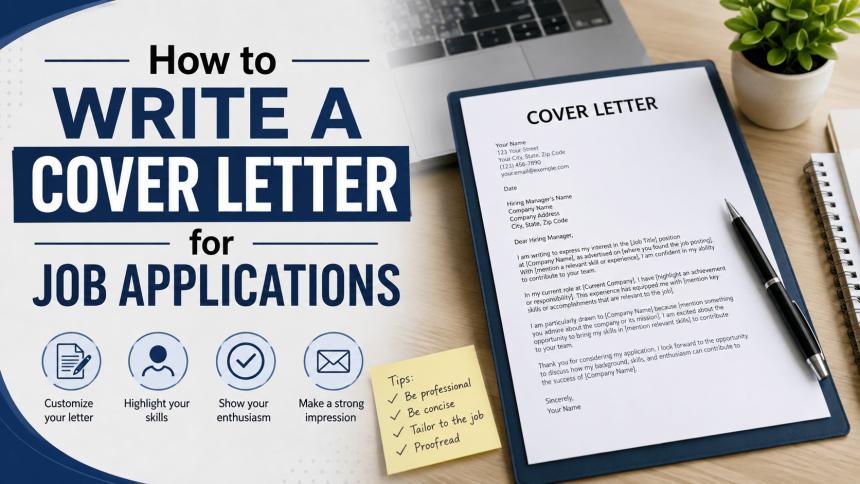
Cover Letter for Job Applications. When applying for a job, your CV is not the only document that can make an impression on a recruiter. A well-written cover letter can introduce you personally, explain why you are interested in the position, and show how your skills and experience match the employer’s requirements.
While a CV focuses mainly on your qualifications, work history, and skills, a cover letter gives you an opportunity to explain who you are, why you want the job, and why you could be a good fit for the company.
A strong cover letter should be brief, professional, and specifically written for the position you are applying for. In most cases, three to five paragraphs are enough.

What Is a Cover Letter?
A cover letter is a short document submitted with your CV when applying for a job. It is usually addressed to the recruiter, hiring manager, or employer and provides additional information about your application.
The purpose of a cover letter is not to repeat everything written in your CV. Instead, it should highlight your most relevant qualifications and explain why you are interested in working for the organization.
You can attach the cover letter with your CV when submitting a printed application, or you can use it as the main content of an email when applying online.
How to Write a Cover Letter
1. Research the Company and Position

Before writing your cover letter, take some time to research the company and understand the position you are applying for.
Read the job advertisement carefully and identify the skills, qualifications, responsibilities, and experience the employer is looking for. You can then use this information to make your cover letter more relevant.
Mentioning something specific about the company or position can also demonstrate that you have made an effort to understand the organization rather than sending the same letter to every employer.
2. Address the Right Person
Whenever possible, address your cover letter directly to the appropriate hiring manager or recruiter.

Using the person’s name can make your application feel more professional and personalized. If the name is not available, you can use a professional greeting such as “Dear Hiring Manager.”
Also double-check the company’s name and other contact details before submitting your application. Spelling the employer’s name incorrectly can create a poor first impression.
3. Write a Strong Introduction
The opening paragraph should immediately explain who you are and which position you are applying for.
Mention the job title and, if available, the job reference number. You can also explain where you found the vacancy.
For example, you might begin by stating your current professional background, your interest in the position, and one key reason why you believe the opportunity is suitable for you.
If you are contacting a company to ask about potential vacancies rather than responding to a specific advertisement, clearly explain the type of position you are interested in.
4. Explain Why You Are Suitable for the Job
The main part of your cover letter should focus on why you are a strong candidate.
Review the requirements in the job advertisement and identify your most relevant skills and experience. Instead of simply saying that you are hardworking or motivated, provide evidence that supports your claims.
You could mention:
- Relevant professional experience
- Technical or industry-specific skills
- Educational qualifications
- Important achievements
- Communication and teamwork abilities
- Experience with similar responsibilities
- Knowledge of the employer’s industry
Try to explain how your experience could help the company. This makes your cover letter more meaningful than simply repeating information from your CV.
5. Show Why the Employer Should Hire You
A good cover letter should answer an important question: Why should the employer choose you?
Use this section to highlight the qualities that make you different from other applicants. Focus on achievements and experiences that are directly connected to the job.
Bullet points can sometimes be useful if you want to present several important qualifications clearly. For example:
- Several years of experience in a relevant field
- Strong knowledge of industry-specific software
- Proven ability to work successfully as part of a team
- Experience managing projects and meeting deadlines
- A record of achieving measurable results
Remember to keep this section relevant to the position rather than listing every skill you have.
6. Finish With a Professional Conclusion
Your final paragraph should be polite and confident. Thank the employer for considering your application and mention that additional information is available in your CV.
You can also express your interest in discussing the position further during an interview.
Make sure your phone number and email address are correct and up to date. The recruiter should be able to contact you easily if they want to discuss your application.
7. Sign Off Correctly
End your cover letter with a professional closing.
If you addressed the recipient by name, a closing such as “Yours sincerely” is appropriate. If you used a general greeting such as “Dear Sir/Madam,” “Yours faithfully” can be used.
Follow the closing with your full name.
Tips for Writing an Effective Cover Letter
Keep these tips in mind before submitting your application:
- Write a new cover letter for every job application.
- Tailor the content to the specific company and position.
- Use the same professional font and general formatting as your CV.
- Check the company’s name and recruitment information carefully.
- Use a professional and positive tone.
- Include relevant keywords from the job advertisement naturally.
- Demonstrate that you have researched the employer.
- Focus on your strongest and most relevant skills.
- Support your claims with examples whenever possible.
- Avoid copying your CV word for word.
- Check spelling, grammar, and punctuation before submitting.
- Keep the letter concise and easy to read.
- Save a copy of every cover letter you submit.
Keeping copies can also help you prepare for an interview because recruiters may ask questions about information included in your application.
Common Cover Letter Mistakes to Avoid
Even a qualified candidate can weaken their application by submitting a poorly prepared cover letter. Avoid using the exact same letter for every job, as recruiters can usually recognize generic applications.
You should also avoid making the letter too long. A cover letter should complement your CV rather than repeat it.
Other common mistakes include:
- Using an informal tone
- Making spelling or grammar errors
- Addressing the wrong company
- Focusing too much on what you want instead of what you can offer
- Including irrelevant information
- Making unsupported claims
- Forgetting to include contact information
- Failing to proofread before sending
Taking a few extra minutes to review your cover letter can make your application look much more professional.
Cover Letter Templates
If you are unsure how to structure your first cover letter, using a professional template can make the process easier. Online platforms such as Canva, MyPerfectCV, and Zety provide cover letter templates that can help you organize your information.
However, a template should only provide the structure. You should always customize the wording, skills, experience, and introduction for the specific job you are applying for.
Conclusion
A cover letter is an important part of many job applications because it allows you to go beyond the information provided in your CV. It gives you an opportunity to demonstrate your interest in the company and explain why your skills and experience make you a suitable candidate.
The best cover letters are short, personalized, professional, and focused on the employer’s needs. Before submitting your application, carefully review the job advertisement, tailor your letter to the position, proofread the content, and make sure your contact details are accurate.