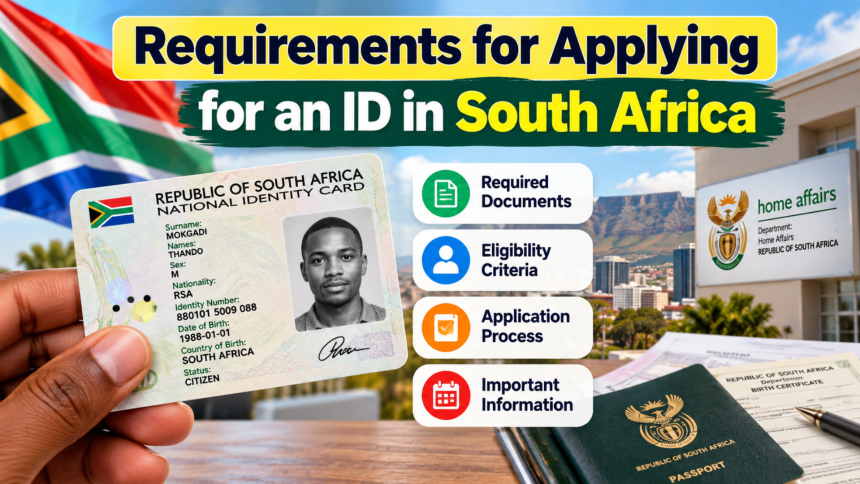
Requirements for Applying for an ID. Getting your first South African Identity Document (ID) is an important milestone in your life. An ID is an essential document that allows you to access various government services, educational opportunities, financial services, and other important activities. Whether you want to write your matric examinations, apply for university admission, receive financial assistance, or open a bank account, having a valid South African ID is necessary.
The Department of Home Affairs is responsible for issuing identity documents to South African citizens. If you are applying for your first ID, the good news is that the initial application is completely free. Understanding the requirements and application process can help you avoid unnecessary delays.
Why Do You Need a South African ID?
A South African ID is one of the most important documents for citizens aged 16 and above. It serves as official proof of identity and is required for many everyday activities.

You may need an ID for the following purposes:
- Registering for and writing matric examinations.
- Applying for NSFAS funding and student bursaries.
- Enrolling at universities and other higher education institutions.
- Opening a bank account and accessing financial services.
- Applying for a driver’s licence.
- Completing government applications and registrations.
- Exercising your right to vote when eligible.

Without an ID, accessing these opportunities and services can become difficult. Therefore, eligible citizens should apply as soon as they reach the required age.
How to Apply for Your First ID in South Africa
The Department of Home Affairs provides several ways for eligible citizens to apply for their first identity document. Applicants can choose the method that is most convenient for them.
1. Book an Appointment Through BABS

You can use the Branch Appointment Booking System (BABS) to arrange an appointment at a participating Home Affairs office. Booking ahead can help you plan your visit and reduce unnecessary waiting.
2. Apply Through eHomeAffairs
Another option is to use the eHomeAffairs online platform. Applicants can complete the available online application steps and, where supported, visit a participating bank branch to complete the process.
3. Visit Your Nearest Home Affairs Office
You can also apply in person by visiting your nearest Department of Home Affairs office. Make sure you have all the required documents before going to the office.
4. Use a Home Affairs Mobile Truck
Home Affairs mobile trucks sometimes visit schools and communities to provide identity document services. If you are a learner, ask your school whether a mobile Home Affairs service will be visiting your area.

Documents Required for a First-Time ID Application
South African citizens who are 16 years or older and applying for an ID for the first time must prepare the required supporting documents.
The general requirements include:
- Your original birth certificate.
- The ID book or Smart ID card of your parent, informant, or legal guardian.
- A parent, informant, or legal guardian who is over 18 years old and a South African citizen to accompany you.
- Your current residential address.
First-time applicants do not need to pay an application fee. They are also not required to bring their own passport-sized photographs, as photographs are generally captured during the application process.
It is important to ensure that the information on your supporting documents is accurate and consistent to prevent complications.
Additional Requirements If Both Parents Are Deceased
Applicants whose parents have both passed away may need to provide additional documentation when applying for their first ID.
Depending on their circumstances, the required documents may include:
- The death certificate of the deceased parent.
- A court order or foster care order if a legal guardian has been appointed.
- An online verification report relating to the informant or guardian.
- Supporting documents confirming the guardian’s legal status.
- Your current residential address.
These documents help Home Affairs verify the applicant’s identity and establish the legal authority of the person assisting with the application.
Applicants should contact their nearest Home Affairs office beforehand to confirm the exact documentation required for their individual circumstances.
What Happens If Your First-Issue ID Is Lost?
If you previously received your first South African ID but have since lost it, you will need to follow the replacement process rather than applying as a first-time applicant.
For a lost ID, the requirements listed in the provided guidance include:
- An affidavit explaining how the identity document was lost.
- Proof of your residential address.
- A payment of R140 for the reissue.
The replacement process is different from the first-time application, which is free of charge. Applicants should confirm the current replacement fee and payment requirements with the Department of Home Affairs before visiting an office.
Conclusion
Applying for your first South African ID is an important step towards accessing education, employment opportunities, banking services, and government programmes. Fortunately, first-time applications are free, and eligible citizens can apply through Home Affairs offices, eHomeAffairs, BABS appointments, or mobile services where available.
Before starting your application, make sure you have your birth certificate, the required parent or guardian identification, and your residential address. Preparing these documents in advance can make the process easier and help you avoid unnecessary delays.