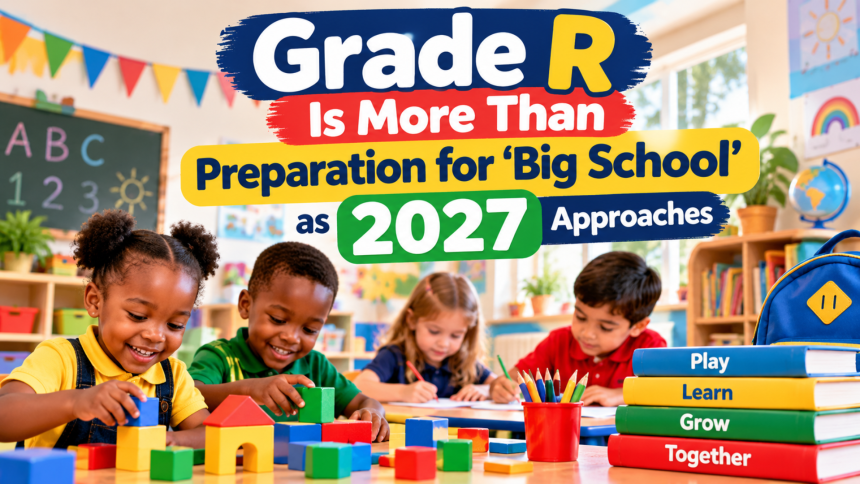
Grade R Is More Than Preparation. For many years, Grade R in South Africa has been viewed mainly as a stepping stone between early childhood and Grade 1. However, as Grade R becomes part of the country’s compulsory schooling framework, attention is increasingly shifting toward the quality of education children receive during this important first formal year.
The discussion is no longer simply about whether children are ready to start school. It is also about whether schools are properly prepared to support young learners and help them develop the skills they will need throughout their education.
Changing Role of Grade R
Grade R has traditionally focused on preparing children for Grade 1. This often includes learning letters and numbers, developing basic language and numeracy abilities, following instructions and becoming familiar with a structured classroom environment.
These academic foundations remain important, but early education can provide much more than preparation for the next grade.

Young children also need opportunities to develop confidence, curiosity, communication skills, creativity and problem-solving abilities. They need to learn how to deal with challenges, ask questions and continue trying when something does not immediately work.
According to Sizwe Nxasana, Group CEO of Sifiso Learning Group and founder of Future Nation Schools, education should not be limited to preparing children for their next academic level. He argues that education should also help young people learn how to think, adapt and make meaningful contributions to their communities and wider society.
Why Quality Grade R Education Matters

The importance of Grade R has received additional attention following its incorporation into South Africa’s compulsory schooling framework through the Basic Education Laws Amendment (BELA) Act.
A Department of Basic Education evaluation found that participation in Grade R had a positive effect on children’s later performance in language and mathematics. However, the impact was not identical across all schools.
These findings highlight the importance of looking beyond attendance and considering the quality of children’s actual classroom experiences.
A strong early-learning environment can help children build academic foundations while also developing skills that support learning in later grades.

Encouraging Curiosity and Independent Thinking
Children naturally tend to be curious. They ask questions, explore their surroundings and want to understand how things work.
An important challenge for early education is maintaining this curiosity as children move into more structured learning environments.
Rather than focusing only on finding the correct answer, classrooms can give children opportunities to investigate problems, discuss ideas and experiment with possible solutions.
Nxasana believes Grade R can provide an important starting point for developing these capabilities. Encouraging children to remain curious can help establish habits that support lifelong learning.
Preparing Children for a Changing Future
Technology is rapidly changing the way people work, communicate and access information. Artificial intelligence is also becoming increasingly important across different industries.
Because of these changes, it is difficult to predict exactly what careers today’s Grade R learners will pursue when they become adults.
Schools therefore face the challenge of developing abilities that remain useful even when technology and employment requirements change.
Skills such as learning independently, asking questions, adapting to unfamiliar situations, communicating effectively and solving problems can help children respond to future challenges.
Instead of trying to predict every future profession, education can focus on giving children the confidence and ability to continue learning throughout their lives.
Future Nation Schools’ Approach to Grade R
Future Nation Schools follows an African-centred educational approach that combines the South African CAPS curriculum with Project-Based Learning and technology.
The approach aims to develop foundational academic skills while also encouraging curiosity, communication and problem-solving.
Project-Based Learning can give children opportunities to explore concepts through practical activities and real-world situations. This can complement traditional academic learning and encourage learners to participate actively in the classroom.
The broader goal is to create an environment where children can develop both their knowledge and the skills needed to apply that knowledge.
Choosing the Right Grade R Environment
With the 2027 school year approaching, parents considering Grade R for their children may want to look beyond basic academic preparation when evaluating schools.
Important factors can include the school’s teaching approach, classroom environment, learning resources and educational values.
Parents can also consider how a school encourages children to communicate, ask questions, work with others and approach unfamiliar problems.
The first formal year of schooling can influence how children view learning and education. A supportive environment can help establish positive attitudes toward school while giving learners the foundations they need for future grades.
Future Nation Schools’ “Start Right, Start Now” Campaign
Future Nation Schools has launched its “Start Right, Start Now” campaign to encourage parents considering Grade R for 2027 to examine the learning environment and teaching approach available to their children.
The campaign highlights the importance of considering the wider educational experience rather than viewing Grade R only as preparation for Grade 1.
Future Nation Schools is also scheduled to host an Open Day on 17 October 2026 at its Fleurhof and Lyndhurst campuses in Johannesburg. The event will give parents an opportunity to learn more about the school’s approach to Grade R and its broader educational model.
Conclusion
Grade R is increasingly being recognised as an important stage in a child’s formal education rather than simply a year spent preparing for Grade 1.
Academic skills such as early literacy and numeracy remain essential, but children can also benefit from developing curiosity, confidence, communication, adaptability and problem-solving abilities.
As Grade R becomes part of South Africa’s compulsory schooling framework, the focus on quality early education is likely to become increasingly important. For parents preparing for the 2027 school year, understanding how schools support both academic development and broader learning skills can help them assess the educational environment available to their children.