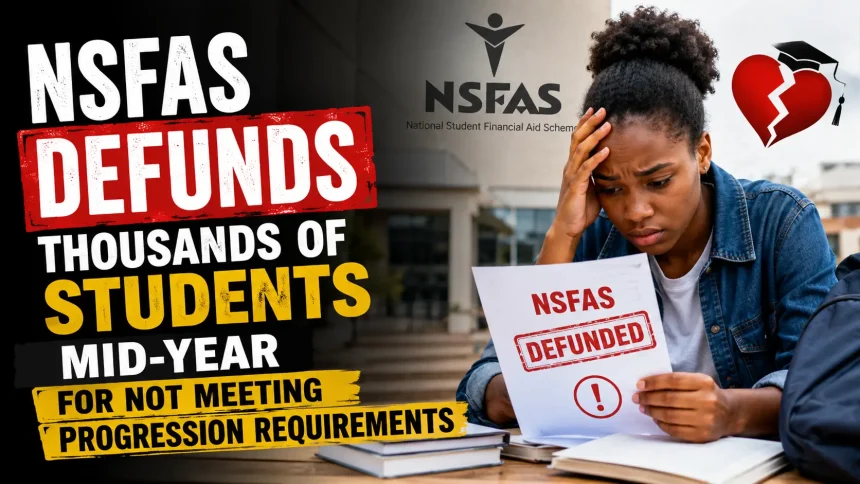
NSFAS Defunds Thousands of Students. The National Student Financial Aid Scheme (NSFAS) has once again placed academic progression at the centre of its funding decisions, with thousands of continuing students facing the loss or withdrawal of financial support after failing to meet the required academic progression criteria.
For students who depend on NSFAS funding to pay tuition fees, accommodation, food and other study-related expenses, losing financial aid can have a serious impact on their ability to remain at university or college. The latest NSFAS information highlights how important it is for funded students to maintain satisfactory academic progress throughout their studies.
What Happened to the Students?
NSFAS assesses continuing students before confirming their funding for the next academic cycle. According to NSFAS’s 2026 funding assessment information, 545,952 continuing university students were assessed. Of these, 416,688 students met the academic progression criteria, while 129,264 students did not meet the required criteria.

This means that a significant number of students were not automatically eligible to continue receiving NSFAS financial support based on their academic results.

Academic progression is an important part of NSFAS funding because the scheme is designed not only to provide financial assistance but also to support students who are making reasonable progress towards completing their qualifications.
What Are NSFAS Progression Requirements?
Students receiving NSFAS funding are expected to meet the academic progression requirements applicable to their institution and qualification. The 2026 NSFAS student-responsibility guidelines specifically state that students must meet academic progression criteria and attendance requirements for their courses and institutions.

Progression requirements can depend on factors such as the student’s programme, academic results, previous study history and the rules applicable to the qualification.
Students should therefore not assume that simply being registered at a university or TVET college guarantees continued NSFAS funding. Funding is subject to the applicable eligibility conditions.
Why Can NSFAS Funding Be Withdrawn?
NSFAS funding is not guaranteed for the entire duration of a student’s studies regardless of academic performance. Continuing students must remain eligible under the applicable rules.
A student who fails to meet academic progression requirements may therefore receive an unsuccessful funding outcome or have continuing funding withdrawn.

There are also other circumstances that can affect eligibility. For example, students must be registered for qualifications that NSFAS funds and must comply with the relevant funding conditions. NSFAS also applies the N+2 rule, with N+3 applying to students with disabilities in specified circumstances.
This is why students are encouraged to understand the funding conditions that apply to their particular qualification rather than relying only on their previous NSFAS approval.
What Does Mid-Year Defunding Mean for Students?
For affected students, the withdrawal of funding can create significant financial pressure.
A student who loses NSFAS support may suddenly have to deal with outstanding tuition fees, accommodation expenses, transport costs, meals and learning materials. Students living away from home may be particularly vulnerable because they often depend heavily on allowances and accommodation support.
The situation can also create uncertainty about whether a student will be able to complete the academic year.
However, students whose continuing financial aid has been withdrawn may have the right to appeal, provided they meet the relevant appeal requirements.
Can Students Appeal an NSFAS Decision?
Yes. NSFAS provides an appeals process for students whose financial aid applications are rejected or whose funding as continuing students has been withdrawn.
According to NSFAS, students have 30 days after being determined unsuccessful to submit an appeal.
An appeal is essentially a request asking NSFAS to reconsider the funding decision. Students should carefully review the reason for their unsuccessful outcome before submitting an appeal and provide relevant supporting information where required.
However, not every student is eligible to appeal. NSFAS states that students who have reached N+2, or N+3 in the case of students with disabilities, generally cannot appeal, subject to specified exceptions. Other restrictions may also apply.
Students should therefore check their individual circumstances and the latest NSFAS appeal requirements before submitting an appeal.
How Students Can Check Their NSFAS Status
Students should regularly monitor their myNSFAS account to check their funding status and any messages from NSFAS.
The official NSFAS system allows applicants and students to track funding progress and identify whether additional action is required. NSFAS advises applicants to check their portal for application outcomes, missing documents and other updates.
If a student receives an unsuccessful funding decision, it is important not to ignore the notification. Students should immediately determine the reason for the decision and establish whether they qualify to appeal.
What Students Should Do After Losing Funding
Students affected by academic progression decisions should take the following steps:
- Log in to the myNSFAS portal and check the latest funding outcome.
- Read the reason for the unsuccessful or withdrawn funding decision.
- Check academic results with the university or TVET college to make sure the information submitted to NSFAS is accurate.
- Determine whether an appeal is allowed under the current NSFAS rules.
- Submit an appeal within the required timeframe if eligible.
- Provide supporting documents where necessary.
- Contact the institution’s financial aid office for assistance and clarification.
- Continue monitoring the NSFAS portal for updates.
Why Academic Progress Matters
The latest developments highlight an important reality for NSFAS-funded students: financial support comes with responsibilities.
Students are expected to remain academically active, meet institutional requirements and make reasonable progress towards completing their qualifications. The 2026 NSFAS guidelines also require students to provide accurate information, notify NSFAS about changes in their qualifications and ensure that they are registered for approved and funded qualifications.
For students who are struggling academically, seeking help early can be crucial. Academic support services, tutors, lecturers and student advisers may help students address difficulties before they affect their progression status.
Conclusion
The defunding of students who fail to meet NSFAS progression requirements demonstrates how closely financial aid is connected to academic performance. With 129,264 continuing university students recorded as not meeting the academic progression criteria in the 2026 assessment, affected students should take their NSFAS status seriously and act quickly when funding is withdrawn.
Students should regularly check their myNSFAS accounts, understand their funding conditions and seek assistance from their institutions when they face academic or administrative problems.