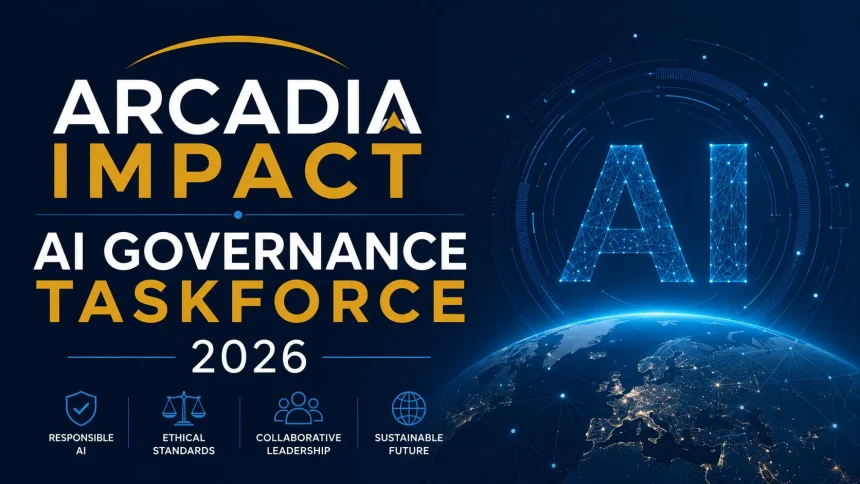
Arcadia Impact AI Governance. Arcadia Impact has opened applications for its Autumn 2026 AI Governance Taskforce, a remote and part-time research programme for professionals interested in building careers in frontier AI governance and reducing the catastrophic and systemic risks associated with advanced artificial intelligence.
The programme is expected to select approximately 20 Research Associates from around the world. Selected participants will take part in a structured 12-week research experience involving policy research, expert mentorship, multidisciplinary teamwork, and the development of research outputs relevant to AI governance.
Applications for the Autumn 2026 cohort are open until 31 August 2026 Anywhere on Earth (AoE).

Arcadia Impact AI Governance Taskforce 2026
The AI Governance Taskforce is designed for experienced professionals who are seriously considering a transition into frontier AI governance. It is a fully remote and global programme, allowing participants to take part without relocating.

The programme requires approximately 8 hours per week, making it suitable for professionals who want to gain experience in AI governance while continuing their existing employment, studies, or other commitments.
Participants work in small multidisciplinary groups of approximately four people. Each team is supported by a Research Team Leader and an expert partner who provides guidance throughout the research process.
Autumn 2026 Programme Details

The Autumn 2026 cohort is scheduled to begin on 12 October 2026 and run until 15 January 2027, including a two-week break around the end of the year.
Key details include:
- Programme: AI Governance Taskforce
- Cohort: Autumn 2026
- Location: Fully Remote
- Eligibility: Global
- Duration: 12 weeks
- Time Commitment: At least 8 hours per week
- Research Associate Positions: Approximately 20
- Employment Type: Voluntary and unpaid
- Application Deadline: 31 August 2026 AoE
- Programme Start: 12 October 2026
Applicants should understand that this is not a salaried employment opportunity. The programme is structured as a voluntary research and professional-development experience.
Who Can Apply?
Arcadia Impact is looking for professionals from a wide range of academic and professional backgrounds. Applicants do not necessarily need extensive technical expertise in artificial intelligence.

Relevant backgrounds may include:
- Law
- Public Policy
- Economics
- Political Science
- International Relations
- Social Sciences
- Humanities
- Management
- Engineering
- Computer Science
- Machine Learning
- Software Engineering
- Systems and Safety
- Philosophy
The programme is particularly relevant to people who already have a strong interest in frontier AI governance and want to make a meaningful career transition into this area.
What Does a Research Associate Do?
Research Associates work with their teams to identify important research questions and develop evidence-based outputs relating to advanced AI governance.
Depending on the project, participants may contribute to:
- Policy research
- Governance analysis
- Long-form research papers
- Policy briefs
- Policy memos
- Preprints
- Articles
- Evidence reviews
- Research communication
The experience can help participants develop practical skills in research, writing, policy analysis, collaboration, and communication.
Expert Mentorship and Networking
One of the key benefits of the AI Governance Taskforce is the opportunity to work alongside experienced professionals and researchers in the AI safety and governance ecosystem.
The programme has previously involved experts and contributors associated with organisations and initiatives such as the UK AI Security Institute, Centre for the Governance of AI, AI Incident Database, MIT AI Risk Initiative, Centre for Long-Term Resilience, SaferAI, and The Future Society, as well as academic institutions.
These connections can help participants understand the field and potentially support future career development in AI governance and AI safety.
What Does Arcadia Impact Look For?
Applicants are assessed on more than their formal qualifications. Arcadia Impact is interested in candidates who can demonstrate genuine motivation and evidence that they are already moving toward work related to frontier AI governance.
Strong candidates may demonstrate:
- Understanding of frontier AI risks
- Strong research ability
- Clear and structured writing
- Policy analysis skills
- Independent thinking
- Strong reasoning
- Transferable professional expertise
- Self-direction
- Good judgement
- Awareness of the AI governance landscape
Applicants should be able to explain why they are interested in frontier AI governance and how their existing skills could contribute to the field.
Application Process
The selection process consists of several stages.
Stage 1 – General Application
Applicants submit a CV and short written responses covering their motivation, understanding of frontier AI risks, transferable expertise, judgement, readiness, and ability to work independently.
Stage 2 – Project Application
Shortlisted applicants receive information about available research projects. They can select projects that match their interests and experience and complete a short written task related to their selected project.
Stage 3 – Interview
Selected candidates are invited to a remote interview where they can discuss their experience, motivation, and application in greater detail.
Stage 4 – Offer
Successful applicants receive an offer to join a specific research project team.
According to the provided programme information, applicants do not need to submit a separate writing sample during the initial application stage.
Important Application Dates
Candidates should keep the following dates in mind:
- Applications Open: 5 August 2026
- General Application Deadline: 31 August 2026 AoE
- Stage 2 Invitations: By 7 September 2026 AoE
- Project Application Deadline: 13 September 2026 AoE
- Interview Invitations: By 21 September 2026
- Offers: Week commencing 5 October 2026
- Programme Begins: 12 October 2026
Applicants should submit their applications before the deadline and carefully review all requirements before applying.
Why Apply for the AI Governance Taskforce?
The programme may be particularly valuable for professionals who already have experience in areas such as law, economics, public policy, technology, international relations, research, or computer science.
Participants can gain practical experience in AI governance research while working with professionals from different disciplines. They can also develop research outputs that demonstrate their ability to contribute to discussions surrounding advanced AI policy and governance.
For individuals planning a career transition into AI governance, the programme can provide structured experience, mentorship, research practice, and professional networking.
How to Apply
Interested applicants should apply through the official Arcadia Impact application process and carefully review the programme requirements before submitting their application.
Applicants should ensure that they can commit at least 8 hours per week throughout the programme and understand that the Research Associate position is voluntary and unpaid.
Before applying, candidates should verify the latest eligibility criteria, deadlines, programme dates, and application instructions directly with Arcadia Impact, as programme details can change.
Conclusion
The Arcadia Impact Autumn 2026 AI Governance Taskforce offers an opportunity for approximately 20 professionals worldwide to gain practical research experience in frontier AI governance. With a remote format, an estimated eight-hour weekly commitment, expert mentorship, and multidisciplinary research projects, the programme may be suitable for professionals seeking to transition into this emerging field.