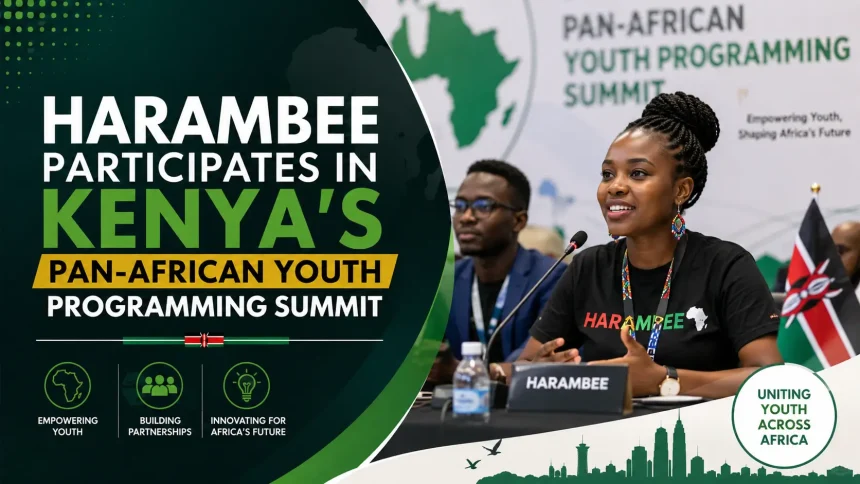
Harambee Participates in Kenya Pan. Harambee has reaffirmed its commitment to improving youth employment and development across Africa by participating in a major continental summit focused on youth programming and collaboration. The event brought together policymakers, researchers, development organisations, and youth advocates from across the continent to explore innovative approaches to supporting young people and creating sustainable opportunities for future generations.
Held in Nairobi, Kenya, from 14 to 17 July 2026, the Youth Shaping Africa’s Present and Future: Insights from Youth Programming Across the Continent Summit served as an important platform for discussing how youth-focused initiatives can be strengthened through collaboration, research, and meaningful youth participation.
Representing Harambee at the summit was Victoria Duncan, the organisation’s Head of Research, who joined experts and stakeholders from across Africa to exchange ideas and share experiences on improving youth development programmes.

Continental Gathering for Youth Development
The summit was convened by the South African Institute of International Affairs (SAIIA) in partnership with the International Development Research Centre (IDRC). It attracted participants from various African countries, creating an opportunity to discuss shared challenges affecting young people while identifying practical solutions that can be adapted across different regions.

Throughout the four-day event, delegates explored the findings of the Youth Programming Innovation Labs, which focus on developing evidence-based approaches to youth empowerment. Discussions centered on how governments, non-profit organisations, academic institutions, and private sector partners can work together to design programmes that better address the realities facing Africa’s growing youth population.
The summit emphasized that young people should not simply be beneficiaries of development programmes but should actively participate in designing and shaping the initiatives that directly impact their lives.
Youth Voices at the Centre of Policy Development

One of the strongest themes emerging from the summit was the importance of ensuring that youth voices remain central to policymaking and programme design.
Delegates discussed how traditional approaches often overlook the lived experiences of young people, resulting in policies that fail to address their actual needs. By involving youth in planning, implementation, and evaluation, organisations can create more effective and sustainable solutions.
Participants also explored concepts such as systems thinking and futures thinking, which encourage decision-makers to consider long-term challenges and interconnected social, economic, and educational factors when designing youth programmes.
These approaches help organisations build initiatives that are adaptable, inclusive, and capable of responding to rapidly changing labour markets and technological developments.

Victoria Duncan Reflects on the Experience
Following the summit, Victoria Duncan described the event as a valuable opportunity to learn from professionals and organisations working across the African continent.
She highlighted the diversity of perspectives shared during the discussions and noted that while many countries face similar youth employment challenges, each nation also has unique circumstances that require tailored solutions.
According to Duncan, hearing about successful programmes from other African countries provided valuable insights that could help strengthen youth employment initiatives in South Africa and beyond.
She also emphasized that cross-border collaboration allows organisations to learn from one another, avoid repeating mistakes, and build stronger evidence-based programmes that better serve young people.
Addressing Africa Youth Employment Challenge
Youth unemployment remains one of the most pressing socio-economic issues across Africa.
Millions of young people enter the labour market each year, yet many struggle to find stable employment due to limited job opportunities, skills mismatches, economic uncertainty, and barriers to accessing quality education and training.
During the summit, participants examined how stronger partnerships between governments, educational institutions, employers, and development organisations can help bridge these gaps.
Discussions focused on creating pathways that connect young people with education, vocational training, entrepreneurship opportunities, internships, and meaningful employment.
Delegates agreed that solving youth unemployment requires coordinated efforts rather than isolated interventions.
Harambee Commitment to Youth Empowerment
Harambee has long been recognised for its work in helping young South Africans transition into the labour market by connecting them with employment opportunities, skills development programmes, and employer networks.
Its participation in the Nairobi summit reflects the organisation’s ongoing commitment to learning from international best practices while contributing its own experience in youth employment solutions.
The organisation believes that meaningful youth participation leads to stronger programmes and better outcomes. Instead of designing initiatives for young people without their input, Harambee supports approaches that involve youth as active partners in decision-making processes.
This philosophy aligns closely with the summit’s overall objective of creating development programmes that are informed by the experiences and aspirations of Africa’s young population.
Collaboration Across Africa
A recurring message throughout the summit was the importance of collaboration between organisations operating in different African countries.
Participants agreed that while individual nations face unique economic and social conditions, many youth-related challenges are shared across the continent.
By exchanging research findings, successful programme models, policy recommendations, and practical experiences, organisations can accelerate progress and avoid duplicating efforts.
Cross-continental collaboration also enables organisations to develop innovative solutions that can be adapted to different local contexts while maintaining a common goal of improving opportunities for young Africans.
Looking Ahead
As Africa continues to experience rapid population growth, investing in young people has become increasingly important for long-term economic development.
The discussions held during the Nairobi summit reinforced the need for inclusive policies, stronger partnerships, and greater investment in education, skills development, entrepreneurship, and employment initiatives.
For Harambee, participating in the event represents more than simply attending an international conference. It reflects the organisation’s dedication to contributing to broader continental efforts aimed at creating sustainable opportunities for young people and ensuring their voices remain at the heart of policy and programme development.
Conclusion
Harambee’s participation in the Youth Shaping Africa’s Present and Future Summit demonstrates its commitment to strengthening youth development through collaboration, research, and innovation. By engaging with experts and organisations from across Africa, the organisation gained valuable insights into the challenges and opportunities facing young people while contributing its own expertise in youth employment.
As governments, development agencies, and community organisations continue working together, initiatives that prioritize meaningful youth participation and evidence-based policymaking are expected to play a crucial role in shaping a more inclusive and prosperous future for Africa’s next generation.