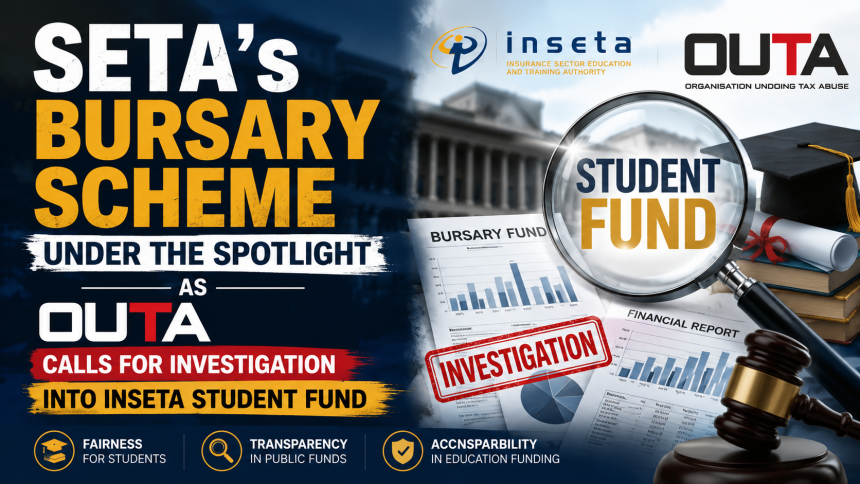
SETA Bursary Scheme Under the Spotlight as OUTA. The Insurance Sector Education and Training Authority (INSETA) is facing growing scrutiny after the Organisation Undoing Tax Abuse (OUTA) called for a comprehensive financial investigation into the management of its Insurance Sector Student Fund (ISSF). The civil society organisation has raised concerns about a dramatic increase in the bursary fund’s budget and questioned whether procurement procedures were properly followed when appointing a service provider to administer the programme.
According to OUTA, its preliminary investigation uncovered several governance and financial issues that warrant closer examination. The organisation is not challenging the concept of SETA-funded bursaries but is instead questioning how public funds were managed and whether procurement regulations were fully complied with.
OUTA Seeks Greater Transparency
OUTA has urged authorities to conduct a full financial investigation into the ISSF after discovering that the project’s budget reportedly increased from around R20 million annually to more than R442.8 million during the 2024/25 financial year.
The organisation believes such a significant increase deserves detailed public scrutiny, particularly because reports suggest that hundreds of students who depended on bursary funding experienced delays in receiving financial assistance.

OUTA has called on INSETA to release the project’s financial records, including the general ledger, to provide a clear picture of how the allocated funds were distributed and spent.
What Is INSETA?
The Insurance Sector Education and Training Authority (INSETA) is one of South Africa’s Sector Education and Training Authorities (SETAs). Its primary responsibility is to address skills shortages within the insurance industry by supporting training, education, and professional development initiatives.

Traditionally, much of INSETA’s work has focused on improving the skills of people already employed within the insurance sector. However, like other SETAs, it has increasingly become involved in supporting students through bursary programmes aimed at developing future industry professionals.
These bursaries are intended to help eligible students cover educational expenses and improve access to higher education opportunities.
Massive Increase in Student Fund Budget
One of the main concerns highlighted by OUTA is the substantial increase in the value of the Insurance Sector Student Fund.
According to the organisation’s findings, the fund was managed internally between 2021 and 2024, with annual project values ranging from approximately R18.6 million to R20 million.

However, during the 2024/25 financial year, the approved budget reportedly rose dramatically to R442,783,502, with recorded expenditure exceeding R158 million under the relevant project code.
OUTA argues that such a large increase in public spending should be accompanied by clear financial reporting and transparent oversight to ensure that taxpayer funds are used appropriately.
Procurement Process Raises Questions
The investigation also focuses on how a service provider was selected to manage the Insurance Sector Student Fund.
According to OUTA, INSETA initially advertised a competitive tender in 2022 for a project management service provider responsible for administering the bursary programme.
Reports indicate that three companies submitted bids before the tender process was eventually cancelled because of insufficient funding.
Despite the cancellation, OUTA says later reports suggested that a service provider was ultimately appointed to manage the bursary fund.
If these reports are accurate, the organisation believes questions need to be answered regarding whether the appointment complied with Supply Chain Management policies, Section 217 of the South African Constitution, and the Public Finance Management Act.
OUTA maintains that procurement processes involving public funds should remain transparent, competitive, and fully compliant with legal requirements.
Students Allegedly Affected by Payment Delays
Perhaps the most concerning aspect of the investigation involves the reported impact on students who relied on bursary funding to continue their studies.
According to information referenced in the investigation, approximately R70 million was reportedly advanced to the service provider responsible for administering bursary payments.
Despite this, around 879 students allegedly failed to receive their bursary payments during the first five months of the academic year.
The reported delays placed many students under severe financial pressure. Some allegedly faced eviction from student accommodation, struggled to purchase food, and risked academic exclusion because essential educational expenses remained unpaid.
OUTA argues that bursary programmes exist to remove financial barriers to education, making any failure to deliver funding to eligible beneficiaries a matter of serious public concern.
Emergency Accommodation Payments
The investigation also claims that INSETA was forced to intervene directly after payment delays threatened students’ accommodation.
According to OUTA, emergency accommodation payments totaling approximately R4.6 million were reportedly made directly to accommodation providers to prevent affected students from losing their housing.
While these emergency measures may have prevented an even greater crisis, OUTA believes they also highlight weaknesses in the administration of the bursary programme.
The organisation argues that students should not have been placed in a situation where emergency interventions became necessary if the funding system had operated effectively from the outset.
Importance of Accountability
OUTA has emphasized that its investigation is focused on ensuring accountability and transparency rather than opposing student bursary programmes.
The organisation supports initiatives that expand educational opportunities but believes public institutions entrusted with managing taxpayer money must operate with the highest standards of governance.
Financial oversight, transparent procurement, and timely delivery of student funding are essential to maintaining confidence in public education support programmes.
Where concerns arise, OUTA says they should be investigated thoroughly to determine whether existing laws and regulations were followed.
Potential Implications
Should a formal investigation proceed, authorities may examine procurement documentation, financial records, payment processes, and governance structures related to the Insurance Sector Student Fund.
Any findings could influence how bursary programmes are managed in the future and may result in recommendations aimed at strengthening financial controls, improving oversight, and ensuring that students receive funding without unnecessary delays.
The investigation could also encourage other public institutions to review their own governance systems to ensure compliance with financial management legislation.
Conclusion
The call for a financial investigation into INSETA’s Insurance Sector Student Fund has placed the administration of SETA-funded bursaries under renewed public scrutiny. While the objective of supporting students through financial aid remains widely supported, OUTA believes that questions surrounding procurement, financial management, and delayed bursary payments deserve careful examination.
As authorities consider the concerns raised, many students and stakeholders will be watching closely for greater transparency and accountability. Ensuring that public funds are managed responsibly and that bursary recipients receive the support they have been promised remains essential for maintaining trust in South Africa’s education funding system.