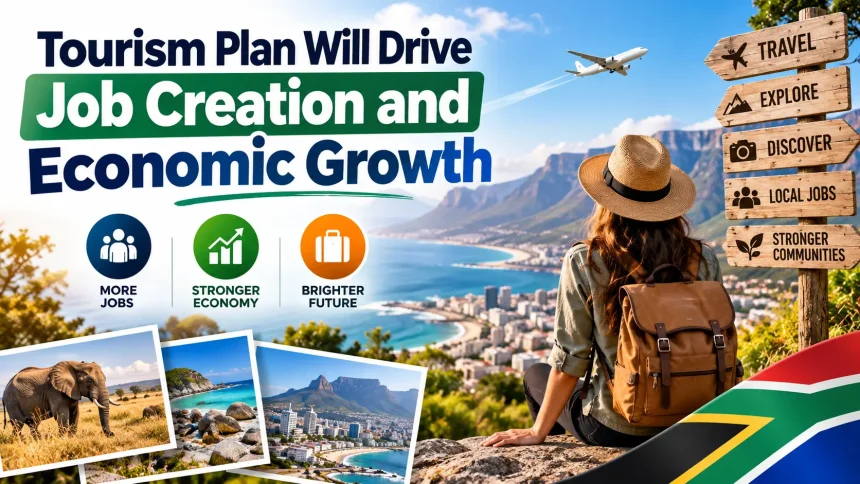
Tourism Plan Will Drive Job. Tourism is becoming an important part of South Africa’s economic growth strategy. The industry creates jobs, attracts investment, brings foreign income into the country, and supports businesses in many different sectors.
From hotels and restaurants to transport, retail, entertainment, and local tourism businesses, millions of people can benefit from a growing tourism industry.
President Cyril Ramaphosa has highlighted the important role tourism can play in creating employment and supporting communities across South Africa. He has also called on government and businesses to work together to remove the barriers that are limiting the sector’s growth.

Tourism Can Create Jobs Across Many Sectors
Tourism is different from many industries because it can create employment for people with a wide range of skills and experience.

When an international visitor arrives in South Africa, they may use an airport, stay at a hotel, eat at restaurants, use transport services, visit attractions, buy products, and take part in entertainment activities.
Each part of this journey supports businesses and workers.

President Ramaphosa explained that tourism can generate jobs across accommodation, transport, food services, entertainment, retail, and creative industries.
He also called for improvements in several areas, including air access, visa processing, destination marketing, tourist safety, and tourism infrastructure.
The government also wants tourism benefits to reach areas outside the country’s most popular destinations. This includes villages, townships, small towns, heritage sites, and national parks.
International Tourist Arrivals Continue to Increase
Recent tourism figures show that international travel to South Africa has continued to grow.

In July 2026, South Africa recorded 991,696 international tourist arrivals. This was a 12.5% increase compared with July 2025.
Growth was also recorded during the first seven months of 2026.
Between January and July 2026, South Africa received 6,576,169 international tourist arrivals. This represented an increase of 12.4% compared with the same period in the previous year.
Tourism growth was seen among both African and overseas visitors.
Arrivals from Africa increased by 14.3% year-on-year, while overseas arrivals increased by 5.7% during the same period.
These figures show the potential for tourism to become an even larger contributor to the South African economy.
Tourism’s Contribution to the South African Economy
Tourism already makes a significant contribution to employment and economic activity in South Africa.
According to available tourism statistics, the sector supported approximately 954,000 direct jobs in 2024.
The industry also contributed around 4.9% to South Africa’s Gross Domestic Product (GDP).
GDP is the total value of goods and services produced within a country. A contribution of this size shows why tourism is an important part of South Africa’s economic plans.
Tourism can also help small businesses. Guesthouses, restaurants, tour operators, transport companies, craft sellers, entertainment businesses, and local attractions can all benefit when more visitors spend money in their communities.
Tourism Growth Is Reaching More Areas
Tourism Minister Patricia de Lille said recent figures indicate that tourism growth is becoming more geographically diverse.
This is important because tourism has traditionally been concentrated around major destinations.
Expanding tourism to smaller towns and less visited areas can create new business opportunities and employment outside major cities.
The government is working with private-sector companies and other tourism stakeholders to continue this growth.
Digital immigration systems are also expected to make international travel easier while maintaining strong border controls.
New Digital Visa System Could Help Tourism
One of the major developments in South Africa’s immigration system is the introduction of the Electronic Travel Authorisation (ETA).
The system is designed to make travel authorisation faster and more secure for eligible international visitors.
Home Affairs Minister Dr Leon Schreiber described the ETA as an important step toward modernising South Africa’s immigration system.
The system uses biometric verification and automated risk analysis.
Biometric verification means that a person’s unique physical characteristics, such as their face, can be used to confirm their identity.
Automated risk analysis can help identify potential fraud and other risks during the application process.
If an ETA application is approved, the traveller can receive the authorisation within 24 hours, according to the government.
The approved ETA can then be stored in the traveller’s digital wallet on their smartphone.
How the ETA System Works
The ETA system uses technology at different stages of the travel process.
After receiving approval, the traveller can keep their authorisation digitally. When they arrive at immigration, biometric verification can be used to confirm their identity.
A camera can compare the traveller’s face with the information connected to their travel authorisation.
This reduces reliance on physical documents that may be lost, damaged, or manipulated.
The system is designed to make the process more efficient while helping immigration officials maintain border security.
Airports Currently Using the ETA System
The Electronic Travel Authorisation system is currently available at four major South African airports.
These include:
- OR Tambo International Airport
- Cape Town International Airport
- King Shaka International Airport
- Lanseria International Airport
The government plans to expand the system to additional entry points in the future.
This expansion could make international travel more convenient and support South Africa’s goal of attracting more legitimate visitors.
Digital Immigration Technology Will Expand
South Africa is also planning to introduce facial recognition technology and EMCS 2.0 at more land and sea ports.
The government is working to expand the digital platform so that it can eventually handle more complex visa categories.
These could include study visas, spousal visas, and work visas.
This means that the digital immigration system could eventually benefit not only tourists but also international students, workers, families, and other people who need permission to enter South Africa.
What This Means for South Africa
A stronger tourism sector can have a wide impact on the country’s economy.
More visitors can mean higher demand for hotels, restaurants, transport, tour operators, shops, entertainment venues, and other services.
It can also create opportunities for small businesses and communities that are located away from major tourist destinations.
At the same time, faster visa processing and improved border technology could make South Africa more attractive to international travellers.
Conclusion
South Africa’s tourism plan is focused on using the sector to support job creation, economic growth, investment, and local development.
International visitor numbers are increasing, while the government is introducing digital systems such as the ETA to improve the travel and immigration process.
With better air access, improved tourist safety, stronger marketing, modern infrastructure, and easier visa processing, tourism could play an even larger role in South Africa’s economy.