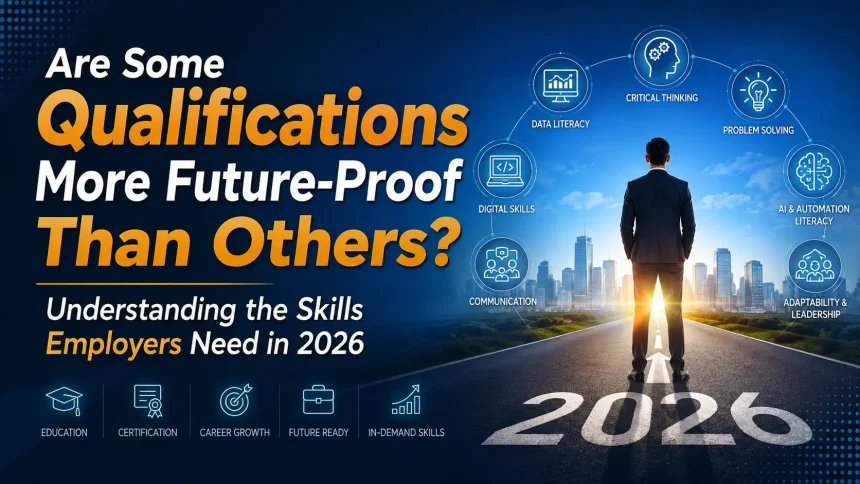
Are Some Qualifications More Future-Proof Than Others. The world of work is changing rapidly, and choosing the right qualification has become more important than ever. While a university or college degree remains valuable, employers are increasingly looking beyond academic results when deciding which graduates are ready to enter the workplace. In 2026, practical skills, adaptability, communication, problem-solving and the ability to work effectively with people are becoming just as important as formal qualifications.
South Africa’s challenging employment environment has highlighted this issue. According to the information provided by Statistics South Africa’s Q2 2026 Quarterly Labour Force Survey, graduate unemployment increased slightly compared with the previous quarter, reaching 12.4%. This demonstrates that obtaining a tertiary qualification does not automatically guarantee employment.
So, what makes a qualification future-proof?

Qualifications Must Go Beyond Academic Knowledge
Traditional qualifications often focus heavily on theoretical knowledge. Although understanding theories and concepts is essential, graduates also need opportunities to apply what they have learned in realistic workplace situations.

Modern employers want people who can take knowledge and turn it into practical solutions. They look for graduates who can communicate with colleagues, solve unfamiliar problems, collaborate within teams, adapt to changing circumstances and contribute to organisational goals.
This shift has encouraged many institutions to place greater emphasis on employability and work-integrated learning. Students who graduate with both academic knowledge and practical experience may have an advantage when entering competitive job markets.
Why Transferable Skills Matter

One of the strongest indicators of a future-proof qualification is the development of transferable skills. These are abilities that remain useful even when someone changes jobs, industries or responsibilities.
Important transferable skills include:
- Problem-solving and critical thinking
- Communication and interpersonal skills
- Emotional intelligence
- Teamwork and collaboration
- Research and data interpretation
- Strategic thinking
- Adaptability and resilience
- Leadership and facilitation
These skills can help graduates remain flexible throughout their careers. Instead of depending on one specific job title, professionals can apply their abilities to different roles and industries.
Growing Importance of Industrial and Organisational Psychology
Industrial and Organisational Psychology (IOP) is one field that combines an understanding of people with knowledge of organisations and business environments. It focuses on how individuals, teams and organisations function and how workplace performance and employee wellbeing can be improved.

According to Carlyn Perils, a lecturer associated with the South African College of Applied Psychology (SACAP), IOP provides students with an opportunity to understand human behaviour in professional environments while considering both organisational effectiveness and employee wellbeing.
This combination can be particularly useful because businesses are ultimately made up of people. Organisations need professionals who understand recruitment, employee engagement, workplace relationships, organisational culture, leadership, change and employee development.
Practical Experience Can Make a Difference
A qualification can become more valuable when students are given opportunities to gain real workplace experience before graduation.
Work-integrated learning can help students understand what professional environments are actually like. It allows them to apply theories, develop professional confidence and learn how organisations operate.
For employers, graduates with practical exposure may require less adjustment when entering their first full-time role. They may already understand workplace communication, professional expectations, teamwork and the importance of ethical decision-making.
This is one reason why students should consider not only the name of a qualification but also how the programme is delivered. A course that combines classroom learning, practical assignments, research and workplace exposure may provide a broader foundation for employment.
AI Is Changing Jobs, But People Remain Important
Artificial intelligence is rapidly changing the workplace. Automation and AI tools are influencing how organisations recruit, communicate, analyse information and complete everyday tasks.
However, technology does not eliminate the need for people who can manage change effectively. Employees may experience uncertainty, anxiety and resistance when new technologies are introduced.
Professionals with an understanding of human behaviour can help organisations manage these transitions. They can contribute to change-management strategies, employee training, reskilling initiatives and workplace wellbeing programmes.
IOP graduates can therefore potentially play an important role in helping organisations understand the human side of digital transformation.
Career Opportunities After an IOP Qualification
Another factor that can make a qualification more future-focused is career flexibility. Graduates should ideally have the opportunity to explore different career pathways instead of being restricted to one narrow profession.
An undergraduate qualification in Industrial and Organisational Psychology can provide a foundation for careers in areas such as human resources, talent acquisition, employee wellness, learning and development, organisational development and change management.
Graduates can also consider further postgraduate education and professional development depending on their career goals and applicable professional requirements.
The combination of psychology, business knowledge and workplace skills can therefore provide graduates with several possible directions.
How Students Can Choose a Future-Proof Qualification
When deciding what to study, students should look beyond salary expectations and qualification titles. They should ask several important questions.
Does the programme provide practical workplace experience? Does it develop transferable skills? Are students taught how to solve real-world problems? Does the qualification prepare learners for technological and organisational change? Can graduates use their skills in more than one industry?
These questions can help students make more informed decisions about their education and long-term career plans.
Conclusion
There is no single qualification that can guarantee lifelong employment. Industries change, technologies develop and employers’ expectations evolve. However, some qualifications may provide a stronger foundation when they combine academic knowledge with practical experience and transferable skills.
Industrial and Organisational Psychology is one example of a field that connects human behaviour, business and workplace performance. Its focus on problem-solving, communication, research, emotional intelligence, organisational development and adaptability can be relevant in a rapidly changing labour market.