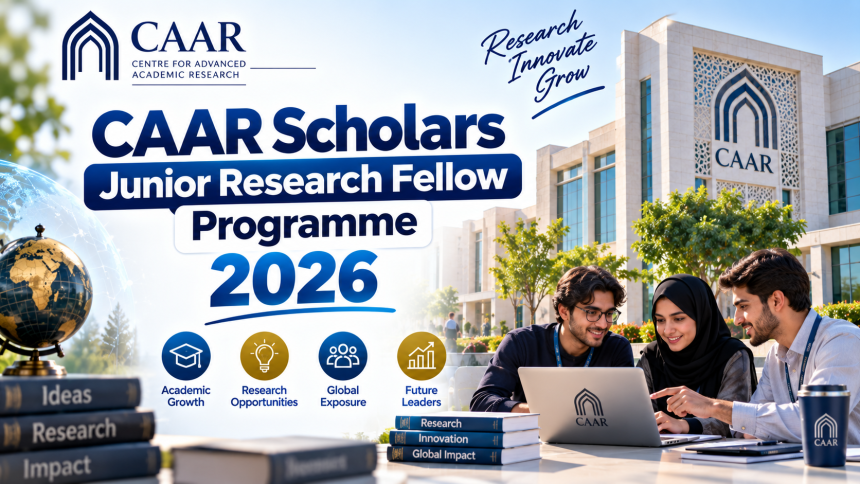
CAAR Scholars Junior Research. Applications are now open for the CAAR Scholars Junior Research Fellow Programme 2026, a six week research fellowship designed for undergraduate students, postgraduate students, recent graduates, early career researchers, and young professionals.
The programme is offered by the Centre for Advanced and Applied Research (CAAR Scholars) and is expected to begin in October 2026. It aims to help participants build practical research skills and gain a better understanding of academic writing, data analysis, research ethics, publication, policy research, and professional development.
This fellowship can be a useful opportunity for young people who want to improve their research abilities and prepare for future academic or professional careers.
The application deadline is 25 September 2026.
CAAR Scholars Junior Research Fellow Programme

The CAAR Scholars Junior Research Fellow Programme 2026 is organised by the Centre for Advanced and Applied Research, a multidisciplinary research and policy organisation working on development related issues in Ghana, Africa, and other regions.
CAAR Scholars works across several areas, including climate and sustainability, governance, economic development, technology, artificial intelligence, environmental management, business, and finance.

The organisation focuses on connecting research with practical problems. Its work includes applied research, policy analysis, capacity building, and engagement with different stakeholders.
Through the Junior Research Fellow Programme, CAAR Scholars aims to give emerging researchers practical knowledge that can support their academic and professional growth.
Programme Duration and Start Date
The fellowship is planned as a six week programme.
According to the available programme information, the 2026 cohort is scheduled to begin in October 2026.

During the programme, participants will take part in learning activities designed to improve their understanding of the research process. They will also have opportunities to interact with researchers and professionals.
Applicants should check the official programme information for the latest details about the exact starting date and programme schedule.
What Will Participants Learn?
The fellowship covers several important areas of research and professional development.
Research Methods
Participants will learn about basic research methods and how researchers approach different questions and problems.
This can help students understand how to develop research questions, select suitable methods, collect information, and organise their research work.
Academic Writing
Academic writing is another important part of the programme.
Participants can develop skills for writing research papers, reports, literature reviews, and other academic documents. These skills can be useful for university assignments, dissertations, research projects, and future publications.
Data Collection and Analysis
The programme also introduces participants to data collection and analysis.
Data analysis means studying collected information to identify useful findings and patterns. Developing this skill can help participants work more confidently with research data.
Research Ethics
Research must be conducted responsibly. For this reason, participants will also learn about research ethics.
This area helps researchers understand responsible practices when collecting information, working with people, handling data, and presenting research findings.
Publication and Policy Research
Participants will also be introduced to publication and policy research.
They can learn how research findings may be developed into useful academic or professional outputs. They can also understand how evidence can support policy discussions and decision making.
Leadership and Professional Development
The programme isn’t limited to technical research skills. It also includes leadership and professional development.
These skills can help young researchers communicate better, work with others, manage research tasks, and prepare for future career opportunities.
Mentorship and Interaction With Researchers
An important part of the CAAR Scholars fellowship is exposure to experienced researchers and guest speakers.
Participants can learn directly from professionals who have experience in research, academia, development, and policy work.
These interactions may help students understand how research works outside the university environment. They can also provide useful insights into academic careers, research projects, publications, and professional development.
For someone who is still deciding which research area to pursue, speaking with experienced professionals can be especially helpful.
Who Can Apply for the CAAR Scholars Fellowship?
The CAAR Scholars Junior Research Fellow Programme 2026 is aimed at people from different academic and professional backgrounds.
The opportunity is open to groups such as:
- Undergraduate students
- Postgraduate students
- Recent graduates
- Early career researchers
- Young professionals
- Applicants don’t necessarily need to already be professional researchers. Students and graduates who are interested in research and want to develop their skills can also consider applying.
- People from different disciplines may be able to benefit from the programme, particularly those interested in research, academic writing, data analysis, policy, development, and leadership.
- Applicants should carefully review the official requirements before submitting an application.
Why Should You Consider This Fellowship?
Research skills can be useful in many career fields. They aren’t only important for people who want to become university researchers.
- Good research skills can help professionals understand information, evaluate evidence, solve problems, and communicate findings clearly.
- For university students, research training can also be useful when preparing for postgraduate education, dissertations, academic projects, and future research opportunities.
- The CAAR Scholars programme combines research training with academic writing, policy research, leadership, and professional development. This makes it relevant to young people who want to build a wider set of skills.
- It may be particularly interesting for applicants who have an interest in African development, policy, sustainability, technology, governance, economics, or applied research.
CAAR Scholars Fellowship 2026 Deadline
The application deadline for the CAAR Scholars Junior Research Fellow Programme 2026 is 25 September 2026.
The six week programme is expected to start in October 2026.
Interested applicants should avoid waiting until the final day. Before applying, carefully review the available programme information and make sure all required details are correctly submitted.
How to Apply for the CAAR Scholars Junior Research Fellow Programme
Eligible students, graduates, early career researchers, and young professionals can submit their applications through the application link provided for the programme.
Application Link:
https://bit.ly/46dJS5F
Applicants who need additional information can contact CAAR Scholars through the following email address:
Email: [email protected]
It is recommended that applicants verify the latest information directly with CAAR Scholars before submitting their application. Programme requirements, dates, and application instructions can change.
Important Information for Applicants
The opportunity is shared for informational purposes. Global South Opportunities is not the organisation offering the fellowship.
Applicants should verify the programme details, eligibility requirements, application process, and deadline directly with CAAR Scholars before applying.
Do not send your application or CV to an organisation that is only sharing the opportunity. Use the official application process provided by the programme organiser.
Conclusion
The CAAR Scholars Junior Research Fellow Programme 2026 offers a six week learning opportunity for students, recent graduates, early career researchers, and young professionals who want to strengthen their research skills.
The programme covers useful areas such as research methods, academic writing, data analysis, research ethics, publication, policy research, leadership, and professional development.
With the programme scheduled to begin in October 2026 and applications closing on 25 September 2026, interested candidates should review the requirements and apply before the deadline.