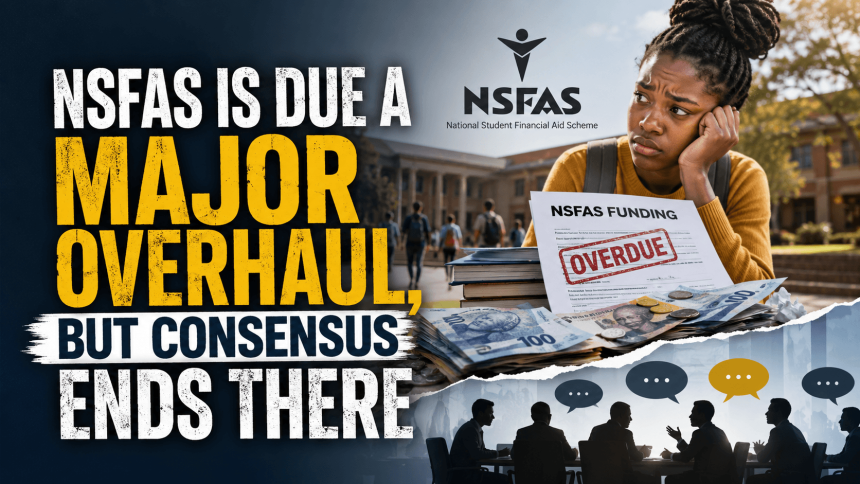
NSFAS Is Due a Major Overhaul. The National Student Financial Aid Scheme (NSFAS) has become one of the most important pillars of South Africa’s higher education system. For millions of students at universities and TVET colleges, NSFAS provides financial support for tuition, accommodation, food, transport and other study-related expenses.
However, in 2026, there is growing agreement that the current NSFAS model cannot continue without significant changes. The real disagreement is about what should replace or reform the existing system. Different political parties, government officials and higher education stakeholders have proposed different solutions, ranging from abolishing NSFAS in its current form to decentralising funding and giving universities greater responsibility.
Why Does NSFAS Need an Overhaul?
NSFAS was originally created to help financially disadvantaged students access higher education. Over the years, its responsibilities and financial scale have expanded considerably.

For the 2026/27 financial year, NSFAS is expected to spend around R54.3 billion, making it one of the largest government-funded student support programmes in South Africa. Its role now goes beyond simply paying university fees because many students also rely on NSFAS allowances for accommodation, meals, transport and other essential living expenses.

The expansion of the scheme has also created significant administrative and governance challenges. Problems involving payments, student accommodation, technology systems and outsourced services have repeatedly affected students and institutions.
The government has acknowledged these challenges. In December 2025, Cabinet recognised systemic problems affecting NSFAS stability and credibility and supported urgent measures to strengthen governance, information technology systems and disbursement mechanisms.
NSFAS Administration and Governance Problems

One of the biggest concerns surrounding NSFAS is governance.
The scheme has experienced repeated leadership and administrative difficulties, with government placing NSFAS under administration as it attempts to restore stability. In August 2026, NSFAS Administrator Professor Hlengani Mathebula submitted a stabilisation plan aimed at rebuilding governance, strengthening institutional safeguards and restoring public confidence.
These reforms are particularly important because NSFAS manages billions of rand in public funds and supports a very large number of students.
Parliament and other stakeholders have also raised concerns about outsourced functions. Questions surrounding student accommodation and intermediary payments have added pressure for greater transparency and accountability.

Student Accommodation Has Become a Major Issue
Accommodation is one of the most difficult areas for NSFAS to manage.
Students who qualify for funding may depend on NSFAS accommodation support to remain enrolled at university or college. Delayed payments to accommodation providers can therefore have serious consequences, including disputes between landlords and students and the risk of students losing their accommodation.
NSFAS released R1.1 billion in overdue accommodation payments in May 2026, after some providers had reportedly gone unpaid for months.
To address these problems, NSFAS has been moving toward a more centralised accommodation system. The organisation has also been developing systems that allow students to apply for accommodation, monitor applications, accept offers and report maintenance issues through a central platform.
A more transparent accommodation system could help reduce payment disputes and make it easier for students to understand where their accommodation funding is going.
Three Main Ideas for the Future of NSFAS
Although there is broad agreement that NSFAS requires major reform, there is no agreement on the best replacement model.
1. Replace NSFAS With Direct Treasury Funding
One proposal is to remove NSFAS in its current form and transfer funding responsibilities directly from National Treasury to universities and other institutions.
Supporters argue that eliminating an additional administrative layer could reduce costs and limit opportunities for mismanagement. Government officials have suggested that such a restructuring could potentially save hundreds of millions of rand.
However, critics question whether universities have the administrative and legal capacity to manage student financial aid on such a large scale.
2. Give Universities Greater Responsibility
Another proposal is to decentralise student funding.
Under this approach, universities would play a much larger role in assessing student financial need and distributing funding, while national government would continue to provide oversight.
Supporters argue that institutions are closer to students and may therefore be able to respond more quickly to funding problems. The Democratic Alliance has supported major structural reform, arguing that the current centralised system is no longer sustainable.
However, decentralisation could also create inconsistencies between institutions and increase administrative pressure on universities.
3. Keep NSFAS but Fix the System
A third option is to retain NSFAS but completely overhaul its operations.
This approach would focus on stronger governance, improved technology, transparent payment systems, better accommodation management and tighter financial controls.
There are already signs that this process is underway. NSFAS completed its 2026 funding decisions before the academic year began, while the organisation has also introduced improvements to accommodation and funding processes.
What Could Reform Mean for Students?
For students, the most important issue is not necessarily the name or structure of the organisation. What matters is whether financial aid reaches eligible students accurately and on time.
A successful NSFAS overhaul should make applications easier, reduce delays, improve communication and ensure that students can clearly understand their funding status.
The 2026 funding cycle shows the scale of the challenge. NSFAS reported receiving 893,847 applications for first-time entering students and confirmed that funding decisions had been processed before the beginning of the academic year.
Future reforms will need to maintain this level of access while improving efficiency and accountability.
Will NSFAS Be Abolished?
At this stage, it would be premature to say that NSFAS will definitely be abolished.
There is strong pressure for change, but different stakeholders have different ideas about the future model. Some favour replacing NSFAS, while others believe the organisation can be repaired through stronger governance and better administration.
The government’s current stabilisation efforts suggest that immediate attention remains focused on fixing governance and operational weaknesses.
Conclusion
NSFAS is clearly at a turning point. The scheme has played a crucial role in expanding access to higher education for financially disadvantaged South Africans, but its growing size and responsibilities have exposed serious weaknesses.
The debate is no longer simply about whether NSFAS needs reform. The bigger question is what the next NSFAS model should look like.
Whether South Africa chooses direct Treasury funding, greater university involvement or a redesigned central NSFAS, the priority should remain the same: ensuring that eligible students receive reliable financial support without unnecessary delays, confusion or administrative failures.