
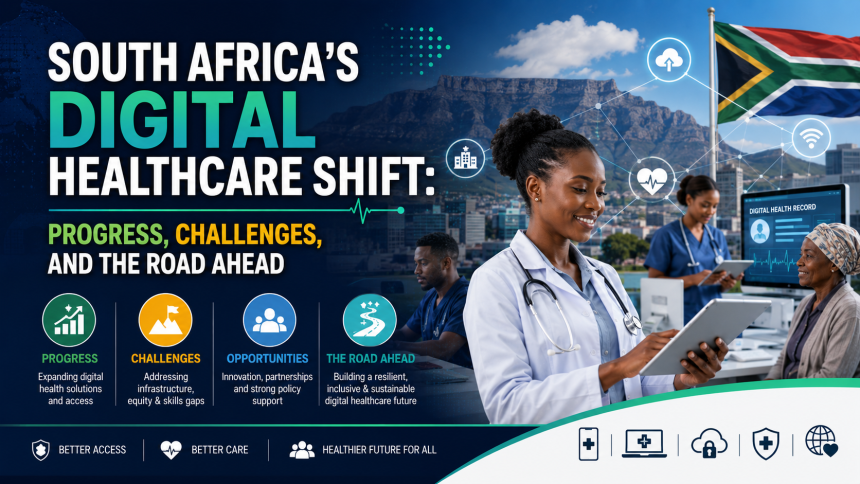
South Africa Digital Healthcare Shift. South Africa is steadily moving toward a more digital healthcare system, transforming how medical services are delivered across the country. From electronic patient records to telemedicine and artificial intelligence (AI), digital technologies are changing the healthcare landscape. While this transformation offers significant opportunities to improve patient care, accessibility, and efficiency, it also presents several challenges that must be addressed before South Africa can fully embrace a digitally connected healthcare future.
The COVID-19 pandemic demonstrated the importance of digital healthcare worldwide. Hospitals, clinics, and healthcare professionals were forced to adopt virtual consultations, online communication, and digital patient management systems almost overnight. These changes proved that technology could play a vital role in ensuring healthcare services remain available during times of crisis. Today, South Africa continues to build on that momentum by investing in digital health initiatives and modernizing its healthcare infrastructure.
South Africa’s Progress in Digital Healthcare
Over the past few years, South Africa has made encouraging progress in expanding digital healthcare services. The government’s National Digital Health Strategy provides a long-term framework for improving healthcare delivery through technology. This strategy focuses on strengthening healthcare systems rather than simply replacing paper records with digital files.

Healthcare facilities across the country have increasingly adopted electronic health records (EHRs), digital appointment systems, and online patient communication platforms. Telemedicine services have also become more common, allowing patients to consult doctors remotely without travelling long distances. This has proven especially beneficial for people living in rural and underserved communities where healthcare services are often limited.

Digital healthcare has also improved disease monitoring and public health surveillance. During recent disease outbreaks, digital systems enabled faster reporting, better tracking of infection rates, and improved coordination between healthcare providers and government agencies.
Although these developments are promising, experts agree that the country still has considerable work ahead before digital healthcare becomes fully integrated into everyday medical practice.
Biggest Challenge: Digital Inequality

Despite technological progress, one of the greatest barriers facing South Africa’s healthcare transformation is digital inequality.
Many South Africans still struggle with unreliable internet access, frequent electricity outages, limited smartphone ownership, and poor digital literacy. These challenges prevent millions of people from benefiting fully from online healthcare services.
Across Africa, internet access remains significantly lower than in many developed regions. Without reliable digital infrastructure, telemedicine, online medical records, and virtual healthcare consultations cannot reach everyone equally.
Digital healthcare should improve healthcare access for all citizens—not create new forms of inequality. Bridging the digital divide requires investment in broadband infrastructure, affordable internet access, reliable electricity, and digital education programs that empower both healthcare workers and patients.

Technology Must Support Better Healthcare
Healthcare experts emphasize that digital transformation should focus on improving patient care rather than simply introducing new technology.
Successful digital healthcare means reducing waiting times, improving diagnosis, increasing access to specialists, minimizing paperwork, and helping healthcare professionals make better clinical decisions through accurate health data.
Artificial intelligence is beginning to support healthcare providers by assisting with medical imaging, data analysis, disease prediction, and administrative tasks. However, AI is designed to support healthcare professionals—not replace them. Human judgment, compassion, and patient interaction remain essential components of quality healthcare.
Preparing Future Healthcare Professionals
As healthcare becomes increasingly digital, universities and medical training institutions have an important responsibility to prepare students for the future workplace.
Modern healthcare graduates are expected to understand electronic medical records, telehealth systems, digital diagnostics, cybersecurity, and healthcare data management. These skills are becoming just as important as traditional clinical knowledge.
Healthcare education must move beyond treating digital health as an optional subject. Instead, digital competencies should be integrated into medical, nursing, pharmacy, and allied healthcare programs from the beginning.
Graduates entering today’s workforce need to feel confident using digital tools while also understanding patient privacy, ethical technology use, and data security regulations.
Lifelong Learning Is More Important Than Ever
Technology evolves rapidly, meaning healthcare professionals must continue learning throughout their careers.
Doctors, nurses, pharmacists, and healthcare administrators need regular training to stay updated on emerging technologies, AI-powered healthcare systems, digital patient management platforms, and evolving cybersecurity practices.
Continuous professional development helps ensure that healthcare workers remain effective, adaptable, and capable of delivering high-quality patient care in an increasingly digital environment.
Healthcare organizations also benefit from investing in staff training because well-prepared employees are more likely to adopt new technologies successfully while maintaining patient safety and service quality.
Strengthening South Africa’s Healthcare System
Digital healthcare has the potential to strengthen South Africa’s healthcare system in many ways.
Remote consultations can improve access to specialists for rural communities. Electronic health records reduce paperwork and improve coordination between healthcare providers. Digital prescriptions, appointment booking systems, and mobile health applications can simplify patient experiences while reducing administrative workloads.
Public health authorities can also use digital systems to monitor disease outbreaks, allocate healthcare resources more efficiently, and improve emergency response planning.
However, technology alone cannot solve healthcare challenges. Investment in infrastructure, healthcare workforce development, policy implementation, cybersecurity, and digital inclusion will determine whether South Africa’s healthcare transformation succeeds.
Conclusion
South Africa’s digital healthcare journey is progressing in the right direction, but significant work remains before the benefits can be enjoyed by everyone.
The National Digital Health Strategy provides a strong vision for the future, while lessons learned during the COVID-19 pandemic have accelerated innovation across the healthcare sector. The next phase requires consistent implementation, improved infrastructure, greater digital access, and better education for both healthcare professionals and the public.
Ultimately, the success of digital healthcare will not be measured by the number of technologies introduced but by the improvements they deliver in patient care, accessibility, efficiency, and health outcomes.