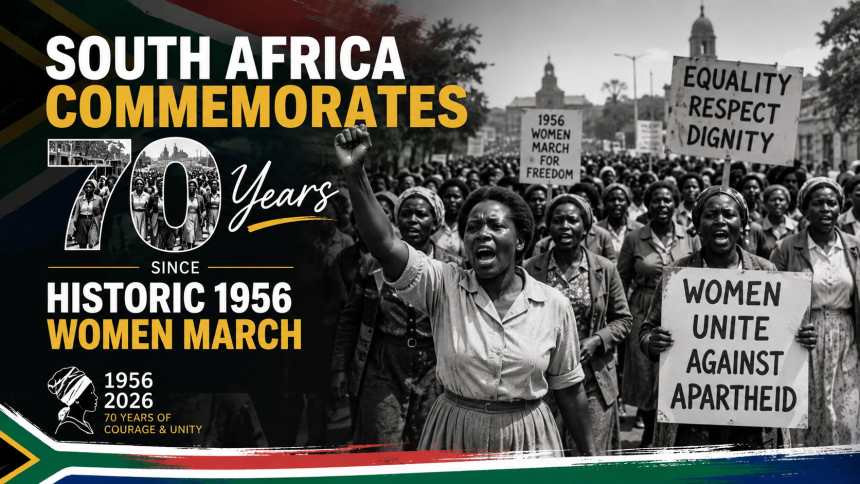
South Africa Commemorates 70 Years. South Africa has marked the 70th anniversary of the historic 1956 Women’s March, remembering more than 20,000 women who stood together against apartheid pass laws. The national commemoration highlighted the courage, leadership and determination of South African women who played a major role in the country’s long struggle for freedom and equality.
The anniversary was commemorated at the Union Buildings in Tshwane, the same place where thousands of women gathered on 9 August 1956 to protest legislation that sought to extend apartheid pass laws to Black women. President Cyril Ramaphosa led the national event and described the historic march as one of the most significant moments in South Africa’s history.
Historic Women March of 1956
On 9 August 1956, more than 20,000 women from different parts of South Africa marched to the Union Buildings. Their primary objective was to oppose the apartheid government’s pass laws, which severely restricted the movement of Black South Africans.

The protesters delivered petitions containing approximately 100,000 signatures. After reaching the Union Buildings, they staged a powerful and peaceful silent protest. For around 30 minutes, thousands of women stood together without chanting or making speeches.

President Ramaphosa said the silence demonstrated courage rather than fear. The women showed that peaceful resistance could send a powerful message to those in authority. Their protest became a defining moment in South Africa’s liberation history and demonstrated the ability of women to organise and lead major political movements.
Four Women Who Led the March
Four prominent leaders became closely associated with the 1956 Women’s March: Lilian Ngoyi, Helen Joseph, Rahima Moosa and Sophie de Bruyn. They represented different communities and backgrounds but were united by their opposition to apartheid discrimination.

Their leadership helped bring thousands of women together for one of the largest demonstrations against the apartheid government at the time.
However, the anniversary is also an opportunity to recognise the thousands of ordinary women who participated in the march. Many of their names and personal stories have not been fully recorded in South Africa’s national historical record.
“Write Her into History” Campaign
During the 70th anniversary commemoration, President Ramaphosa welcomed the “Write Her into History” campaign. The initiative, led by the Ahmed Kathrada Foundation and the Sophia and Henry De Bruyn Legacy Foundation, aims to identify and document the names and stories of women who participated in the 1956 march.
The campaign encourages families and communities to share information about relatives who took part in the historic demonstration.

Documenting these stories is important because history is not only shaped by famous leaders. Thousands of ordinary people contributed to South Africa’s struggle for democracy, and preserving their experiences can help future generations understand the sacrifices made during the apartheid era.
Progress in Women’s Empowerment
The 70th anniversary also provided an opportunity to reflect on South Africa’s progress since democracy was established in 1994.
Women today hold important positions across government and public institutions. Women have served as ministers and deputy ministers and have occupied senior positions such as Chief Justice, Speaker of the National Assembly, Chairperson of the National Council of Provinces, Public Protector and Auditor-General.
Ramaphosa said these achievements were the result of generations of struggle and sacrifice. He stressed that progress must not be taken for granted and that the gains achieved by women need to be protected.
South Africa has also made progress in areas including political representation, education, financial inclusion and gender equality. These developments represent an important part of the legacy created by generations of women who fought for greater rights.
Gender-Based Violence Remains a Major Challenge
Despite progress, South African women continue to face serious challenges. One of the most significant is gender-based violence and femicide (GBVF).
During the commemoration, President Ramaphosa acknowledged that many women today continue to live with fear because of violence in their homes, communities and public spaces. He stressed that GBVF is not simply a women’s issue but a wider social problem that requires action from government, communities, families and individuals.
The President also called on men and boys to become actively involved in preventing violence against women. He emphasised the importance of changing attitudes and behaviours that contribute to violence and encouraged community, traditional and religious leaders to support prevention efforts.
Call for Equality and Safety
The President urged South Africans to honour the women of 1956 by continuing to build a society where women can live with dignity, safety and equal opportunities.
He highlighted the need for a South Africa where women are equal under the law, have equal access to opportunities and can participate fully in political, economic and social life.
The message of the 1956 Women’s March therefore remains relevant decades later. The march was not only about opposing apartheid pass laws; it also demonstrated the importance of unity, courage and collective action.
Sophie de Bruyn Encourages Young Women
Sophie de Bruyn, one of the four leaders of the 1956 Women’s March, also reflected on the historic event and encouraged younger generations to continue confronting the challenges facing South Africa.
Among the issues requiring attention today are gender-based violence, corruption and inequality. De Bruyn recalled the solidarity and determination of the women who participated in the 1956 protest and highlighted the importance of carrying that spirit forward.
Her message serves as a reminder that every generation has a responsibility to protect democratic values and continue working toward a fairer society.
Remembering the Legacy of 1956
The 70th anniversary of the Women’s March is more than a historical commemoration. It is an opportunity for South Africans to remember the courage of women who challenged an oppressive system and helped shape the country’s democratic future.
The events of 1956 demonstrated that women were not merely observers or supporters in the struggle against apartheid. They were organisers, leaders and activists who helped change the course of South African history.
Conclusion
As South Africa remembers the thousands of women who marched to the Union Buildings 70 years ago, the anniversary also provides an opportunity to look toward the future. Their legacy calls for continued efforts to eliminate discrimination, expand opportunities for women, address inequality and create a society free from violence.
The 1956 Women’s March remains one of the strongest symbols of women’s resistance and leadership in South Africa. Its 70th anniversary reminds the nation that the courage shown by those women continues to inspire new generations to stand for equality, justice and human dignity.