Tax Refund Work Harder. Receiving a tax refund from the South African Revenue Service (SARS) can feel like an unexpected financial bonus. After months of managing household expenses, bills and other financial commitments, seeing extra money arrive in your bank account can make it tempting to spend immediately on a holiday, shopping or entertainment.
However, a tax refund is not really “free money.” It is money that belonged to you in the first place and is being returned after your tax affairs have been assessed. Instead of treating the refund as spending money, you can use it as an opportunity to strengthen your financial position and work towards long-term goals.
Whether you receive a small or substantial refund, making a plan before the money arrives can help you get much more value from it.

1. Pay Down Expensive Debt
One of the most effective ways to use a tax refund is to reduce high-interest debt. Credit cards, personal loans, vehicle finance and other expensive forms of borrowing can consume a significant portion of your monthly income through interest charges.

Using your refund to make an additional payment can reduce the amount of interest you pay over time. The best approach is generally to identify debts with the highest interest rates and prioritise them.
For example, if you have a personal loan charging a high interest rate, paying a lump sum towards the outstanding balance can reduce future interest costs. Once one debt has been cleared, you can redirect the money that was previously used for its monthly repayment towards another debt.

Another approach is the debt snowball method, where you focus on clearing smaller balances first. Although this may not always minimise interest mathematically, eliminating individual accounts can provide motivation and make your overall debt easier to manage.
The important point is to ensure that your refund is reducing financial pressure rather than creating new spending.
2. Strengthen Your Retirement Savings
A tax refund can also be used to improve your retirement position. Retirement savings benefit from long investment periods because investment returns can compound over many years.
A retirement annuity (RA) is one option worth considering for eligible South African taxpayers. Contributions to qualifying retirement products can provide tax benefits subject to applicable rules and limits.

The potential advantage becomes even more interesting when you reinvest the tax benefit rather than spending it. Instead of using the refund for immediate consumption, you could put some or all of it back into your long-term investment strategy.
Over several decades, regularly investing additional amounts can make a significant difference because your contributions can generate returns, and those returns can themselves generate further returns.
For example, someone who consistently invests an annual amount and reinvests associated tax savings could potentially build a considerably larger retirement portfolio than someone who spends those refunds every year. Actual results will depend on investment returns, fees, tax rates, contribution limits and personal circumstances.
3. Consider a Tax-Free Savings Account
A tax-free savings account (TFSA) is another option for long-term wealth creation in South Africa.
Unlike retirement contributions, TFSA contributions do not generally provide an upfront tax deduction. However, qualifying investment returns within the account can receive favourable tax treatment, subject to the applicable annual and lifetime contribution limits.
This makes a TFSA potentially useful for people who want to build long-term savings without paying tax on qualifying interest, dividends and capital gains within the account.
If you already have an emergency fund and manageable debt, putting part of your tax refund into a suitable TFSA could help you build wealth over time.
It is important to remember that contribution limits and tax rules can change, so taxpayers should check the latest SARS and National Treasury rules before making investment decisions.
4. Build or Top Up an Emergency Fund
Not every financial priority involves investing. Sometimes the smartest use of a tax refund is simply creating a cash safety net.
Unexpected expenses can appear at any time. A vehicle repair, medical expense, household emergency or temporary loss of income can quickly put pressure on a household budget.
Without emergency savings, people may have to rely on credit cards or personal loans to cover unexpected bills. This can turn a temporary problem into a long-term debt burden.
Using your refund to establish or increase an emergency fund can therefore provide both financial protection and peace of mind.
The ideal emergency-fund amount depends on your income, expenses, job stability and household circumstances. Even starting with a modest amount can be useful if you currently have no emergency savings.
5. Give Your Refund a Specific Purpose
One of the biggest mistakes people can make is allowing a refund to sit in their bank account without a plan.
Once the money becomes available, everyday spending can quickly absorb it. A meal here, a shopping trip there and a few unnecessary purchases can eventually consume the entire refund.
Instead, decide what your refund will do before you receive it.
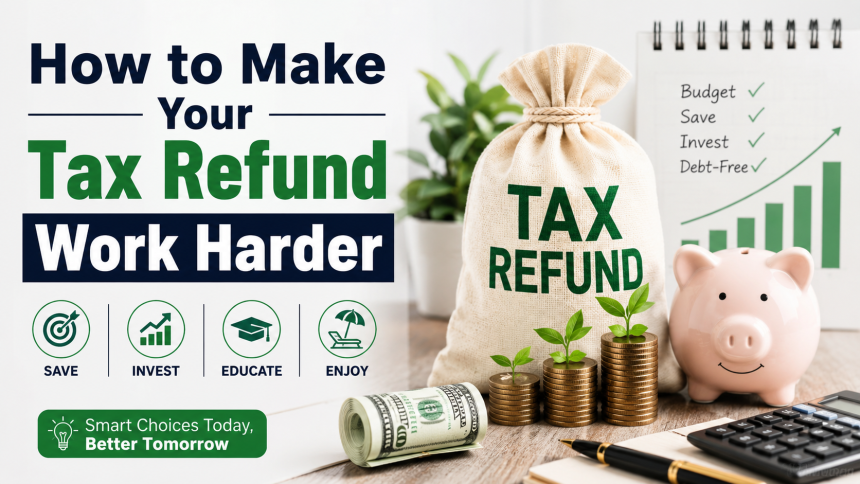
You could divide the money between several priorities. For example, part could go towards debt repayment, another portion towards emergency savings and the remainder towards retirement or long-term investments.
This approach allows you to address immediate financial needs while still making progress towards future goals.
6. Think of Your Refund as Part of a Financial Strategy
There is no single answer for everyone. Someone with expensive debt and no emergency savings may benefit more from paying down debt than investing the entire refund.
On the other hand, someone who is debt-free, has sufficient emergency savings and is already investing regularly may want to prioritise retirement or long-term investments.
Your age, income, tax bracket, financial goals, existing investments, debt interest rates and need for access to the money can all influence the right decision.
This is why comparing several options before spending the refund can be valuable. If you are unsure about the best strategy, consider speaking with a qualified financial adviser who can assess your individual circumstances.
Plan Before the Refund Arrives
The smartest time to decide what to do with your SARS tax refund may be before the money reaches your bank account.
Rather than waiting for the notification and then deciding how to spend the money, establish a plan when you complete your tax return. You can decide in advance how much will go towards debt, savings, investments or other important financial goals.
A tax refund may feel like a financial windfall, but it can be much more valuable when treated as an opportunity rather than spending money.
Conclusion
With careful planning, your refund can help reduce debt, strengthen your emergency fund, increase retirement savings or build long-term wealth. Instead of disappearing into a short-term shopping spree or holiday, that lump sum can become part of a much bigger financial plan.
The key is simple: give your tax refund a job before you spend it. A refund may be temporary, but the financial benefits of using it wisely can continue for many years.