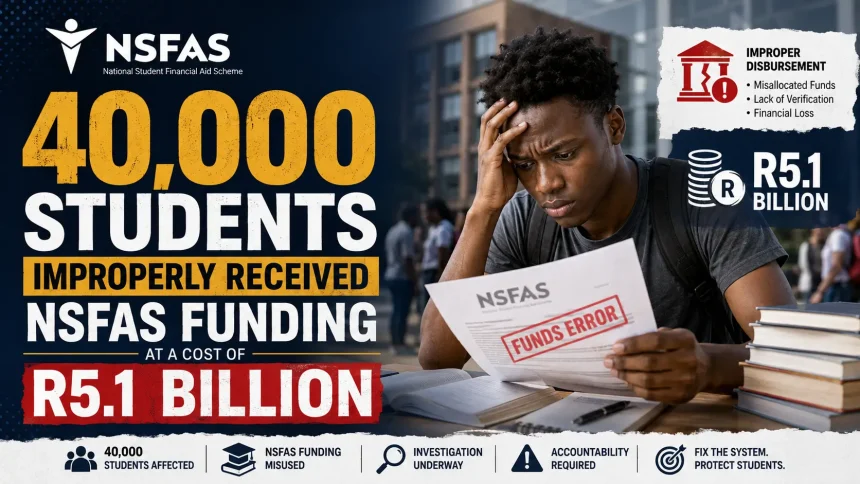
40,000 Students Improperly Received NSFAS Funding. The National Student Financial Aid Scheme (NSFAS) is facing serious scrutiny after an investigation found that more than 40,000 students were improperly funded, with the financial impact estimated at approximately R5.1 billion.
The findings are contained in an investigation conducted by Public Protector Kholeka Gcaleka into the administration of NSFAS. According to the report, the affected students were spread across 76 higher education institutions.
More Than R2 Billion Recovered
The investigation found that funding was improperly provided to more than 40,000 students. However, more than R2 billion of the money has reportedly since been recovered.

Gcaleka said information presented by the Special Investigating Unit (SIU) to Parliament’s Standing Committee on Public Accounts was among the developments that raised concerns about the way NSFAS was being administered.
The SIU investigations, conducted under Proclamation R88 of 2022, identified thousands of students who had received funding improperly.
When these findings were considered alongside complaints received by the Public Protector, engagements with stakeholders and other oversight findings, concerns emerged about possible systemic maladministration within NSFAS.
Administrative Problems Affecting Students

The concerns identified in the investigation extend beyond improper funding. The Public Protector also highlighted several administrative failures that have affected students who depend on NSFAS for financial support.
Some students have experienced delays in receiving confirmation of their funding, while others have faced problems with allowance payments and the processing of appeals. There have also been delays in settling tuition accounts with higher education institutions.
These administrative challenges can create significant difficulties for students, particularly those who rely on NSFAS to cover their education-related expenses.
In some cases, students have reportedly experienced delays in receiving their qualifications because outstanding institutional accounts had not been settled.

NSFAS Has Faced Long-Standing Challenges
According to Gcaleka, the latest findings are not the first indication that NSFAS has experienced serious administrative difficulties.
Independent reviews, including the 2021 Ministerial Committee of Enquiry, had previously concluded that NSFAS was operating in what was described as a near-permanent state of crisis.
The latest investigation therefore raises broader questions about the scheme’s ability to administer student financial aid efficiently and provide reliable support to eligible students.
Questions Over Financial Management
NSFAS plays an important role in helping eligible students access higher education by providing financial assistance. Because of this, accurate assessment of applications, timely payments and effective administration are essential.
The discovery that more than 40,000 students were improperly funded has raised concerns about the effectiveness of existing systems and controls.
The recovery of more than R2 billion represents a significant portion of the money involved, but the findings also highlight the need to address the administrative weaknesses that allowed improper funding to occur.
Impact on Students
For students, administrative problems within NSFAS can have consequences beyond financial uncertainty. Delays in funding confirmation, allowances, appeals and tuition payments can affect their ability to continue their studies without disruption.
Students whose institutional accounts remain unsettled may also face additional difficulties, including delays related to academic records or qualifications.
The Public Protector’s findings underline the importance of ensuring that NSFAS processes applications and payments accurately and within reasonable timeframes.
Conclusion
The investigation into NSFAS has highlighted significant concerns surrounding both improper funding and administrative failures. More than 40,000 students were identified as having been improperly funded at a cost of approximately R5.1 billion, while more than R2 billion has reportedly been recovered.
The findings also point to wider systemic problems, including delays in funding confirmations, allowance payments, appeals and the settlement of tuition accounts.
With thousands of students relying on NSFAS for financial assistance, addressing these shortcomings will be important to ensure that eligible students receive the support they need in a timely and reliable manner.