
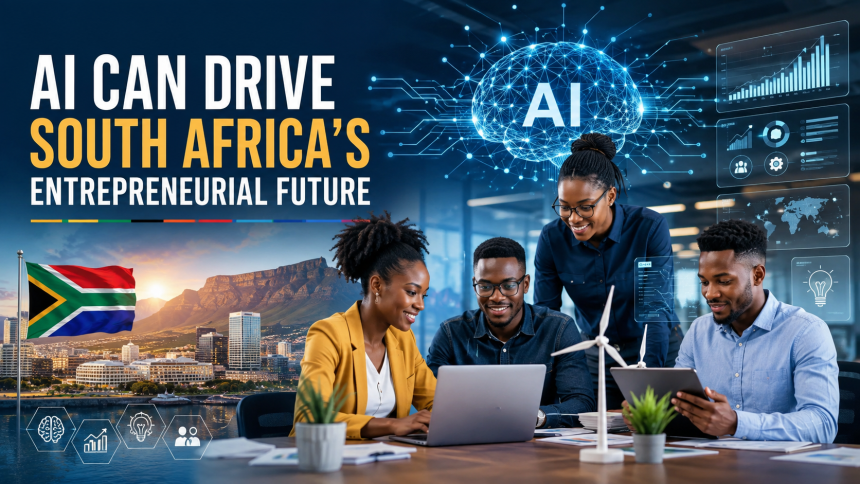
AI Can Drive South Africa Entrepreneurial. Artificial intelligence (AI) is rapidly changing the way businesses operate, and South Africa is well positioned to use this technology to strengthen entrepreneurship, innovation and economic growth. Rather than simply copying successful technology companies from other parts of the world, South African entrepreneurs have an opportunity to use AI to solve problems that are specific to local communities and industries.
Entrepreneurship already plays an important role in South Africa’s economy. Small businesses, startups and informal enterprises contribute to employment, innovation and economic activity across the country. As digital platforms, automation and AI become more accessible, entrepreneurs have new tools to improve their operations, reach customers and develop innovative products and services.
Solving Local Problems With Technology
According to Farad Chohan, School Manager at the MANCOSA School of Information and Digital Technology (SIDT), the biggest opportunity for African entrepreneurs is not necessarily to build local versions of major global technology companies. Instead, entrepreneurs should focus on identifying everyday problems that existing systems have failed to solve.

Africa’s experience with mobile financial services provides an excellent example. Because traditional banking infrastructure was not equally accessible everywhere, innovators developed mobile-based solutions that allowed people to participate in financial services in new ways.

The same approach can be applied to transportation, informal businesses, healthcare, education and other sectors. South Africa’s public taxi industry, for example, represents an area where digital platforms could potentially improve communication, payments, scheduling and customer experiences.
The important lesson is that innovation does not always have to involve creating something completely new. Sometimes, the most successful ideas come from finding a better and simpler way to solve an existing problem.
AI Should Be a Tool, Not the Starting Point
The growing popularity of AI has encouraged many organisations and entrepreneurs to introduce artificial intelligence into their products and business processes. However, starting with technology instead of a genuine problem can result in solutions that provide little real value.
Chohan argues that students and entrepreneurs need knowledge of AI, machine learning and related technologies, but technical knowledge alone is not enough. The more valuable skill is understanding a problem and deciding whether AI is actually the right solution.
This approach can help entrepreneurs avoid using AI simply because it is popular. In some situations, a basic digital platform, improved customer service process or simple automation may be more effective than a complicated AI system.
Entrepreneurs who understand both technology and customer needs will therefore have an advantage in the evolving digital economy.

New Careers Will Emerge
AI is often discussed in terms of jobs that automation could replace. However, the development of artificial intelligence is also creating entirely new career opportunities.
South Africa’s education system will need to prepare students for these emerging roles. Potential careers include AI project managers, AI auditors, AI ethics specialists, data professionals and domain experts who understand how AI can be applied within specific industries.
Instead of training graduates to depend on a particular platform or software tool, educational institutions can focus on developing adaptable professionals who can learn and work with new technologies as they emerge.
This is particularly important because AI technology is developing much faster than traditional education and curriculum systems.
Education Must Keep Up With Industry
The relationship between education and technology is becoming increasingly important. Businesses need employees who understand digital tools, data and automation, while students need skills that remain relevant as technology changes.
MANCOSA’s approach reflects this growing need by incorporating technology into programmes beyond traditional information technology qualifications. Students studying business, commerce and entrepreneurship can also benefit from exposure to digital transformation, analytics and AI.
For example, marketing students can learn how data and AI-supported tools influence customer behaviour. Finance students can explore fintech and automation, while entrepreneurship students can learn how digital platforms can help businesses reach customers and scale.
MANCOSA’s School of Information and Digital Technology covers areas such as artificial intelligence, cybersecurity, data science, cloud computing, blockchain and digital transformation, highlighting the growing importance of technology across different professions.
Africa’s Languages Offer a Major Opportunity
One of the most promising areas for African AI innovation is language technology. Africa has thousands of indigenous languages, yet many mainstream digital and AI systems have historically been developed using datasets that do not adequately represent African languages and cultural contexts.
This creates both a challenge and an entrepreneurial opportunity.
Developing high-quality datasets and AI tools for African languages could make digital services more accessible to communities that are currently underserved by mainstream technology. Entrepreneurs could build applications for education, customer service, healthcare, government services and commerce using local languages.
However, data ownership and data sovereignty must also be considered. African innovators need to ensure that local data is collected responsibly, protected appropriately and used in ways that benefit the communities from which it originates.
The objective should not simply be to reproduce foreign technology. Instead, entrepreneurs should create solutions that genuinely understand the environments in which they will operate.
Entrepreneurs Should Start Instead of Waiting
Technological development often moves faster than regulation, education and infrastructure. Entrepreneurs who wait for perfect conditions may miss opportunities in rapidly changing markets.
Building a successful business does not necessarily require a perfect product from the beginning. Testing ideas, receiving customer feedback and improving solutions can help entrepreneurs understand what their markets actually need.
South Africa still faces challenges involving digital access, infrastructure, skills development and regulation. These issues cannot be ignored. Governments, educational institutions and businesses all have roles to play in creating an environment where technology can be used effectively.
Nevertheless, these challenges should not prevent entrepreneurs from experimenting with new ideas.
Building Africa’s Digital Future
South Africa’s entrepreneurial future could be significantly influenced by AI, but the technology itself will not determine the outcome. The real difference will come from how entrepreneurs choose to use it.
Africa does not need to become another Silicon Valley. It needs entrepreneurs who understand local communities, identify meaningful problems and use technology to create practical solutions.
AI can help businesses automate repetitive work, analyse information, improve customer experiences and develop new products. But its greatest value may come from enabling African entrepreneurs to address challenges that have traditionally received limited technological attention.
Conclusion
The future of African entrepreneurship will therefore depend on a combination of technology, education, creativity and local knowledge. By developing adaptable skills and focusing on real community needs, South African entrepreneurs can move beyond simply consuming global technology and become creators of solutions designed for Africa.
As AI continues to transform the global economy, South Africa has an opportunity to build its digital future from within—one local problem, innovative idea and entrepreneurial solution at a time.