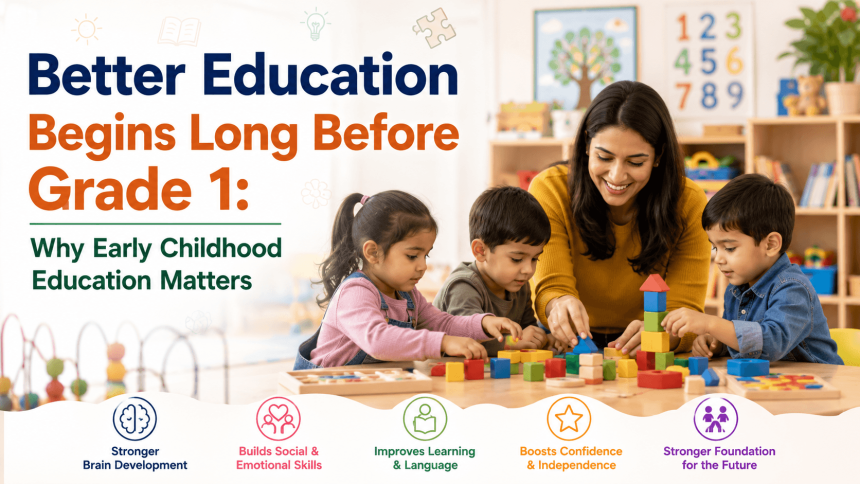
Better Education Begins Long Before Grade 1. Education is often discussed in terms of what happens once children enter primary school. Literacy, numeracy, teacher quality, school infrastructure and classroom resources are all important parts of improving educational outcomes. However, a child’s learning journey begins much earlier than Grade 1. The experiences children have during their earliest years can influence their language development, confidence, relationships, emotional wellbeing and ability to learn in the future.
Recognising the importance of these formative years, STADIO has introduced a new Higher Certificate in Early Childhood Care and Education (ECCE), designed to help develop the knowledge and skills of people working with young children.
Importance of the Early Years
The first few years of life are a period of rapid development. During the first 1,000 days, children experience significant physical, emotional and cognitive growth. Development continues at a remarkable pace throughout the first five years, making this period particularly important for establishing strong foundations for future learning.

This leads to an important question: how can society prepare children for lifelong learning rather than simply preparing them for their first day at school?

According to Kerri-Lee Schneider, Discipline Leader at STADIO, the answer includes ensuring that the people caring for and educating young children have the appropriate knowledge and professional preparation.
Children require much more than basic supervision. They need safe and supportive environments, proper nutrition, emotional care and opportunities to explore their surroundings. They also need adults who understand how children communicate, form relationships, develop socially and emotionally, and learn through everyday experiences.
Early Childhood Development Supports Future Learning

South Africa has increasingly recognised the importance of Early Childhood Development (ECD). In April 2022, responsibility for ECD was transferred from the Department of Social Development to the Department of Basic Education. This change reflected a growing understanding that early childhood development is closely connected to the country’s wider education system.
The concept of Early Childhood Care and Education is particularly important because it combines two essential elements: care and education.
Young children cannot learn effectively without having their basic physical and emotional needs addressed. At the same time, care alone is not enough. Children need opportunities to communicate, play, investigate, ask questions and interact with others.
One of the biggest misconceptions about early childhood education is that it is simply a form of babysitting. In reality, quality ECCE requires an understanding of child development and intentional approaches to learning.

Play Is a Powerful Learning Tool
For young children, play is one of the most important ways of understanding the world. Through play, children can develop language, problem-solving skills, creativity, communication and social abilities.
This does not mean that early childhood centres should simply reproduce the formal classroom environment used in Grade 1. Young children learn differently, and effective early learning should reflect their age, interests and developmental needs.
Play-based learning can allow children to experiment, make decisions, interact with others and develop confidence in a natural environment. Skilled early childhood practitioners understand how to create activities that support development while allowing children to enjoy the process of learning.
Creating Professional Opportunities in ECCE
South Africa already has many people working with young children who have gained valuable knowledge through years of practical experience. Some have completed short courses or workplace training, while others have developed their skills primarily through experience.
However, access to formal higher education qualifications can sometimes be difficult for these practitioners, particularly when pathways begin at higher qualification levels.
Professionalising the ECCE sector should therefore include accessible opportunities for existing practitioners to expand their knowledge and formalise their skills.
STADIO aims to contribute to this process through its new Higher Certificate in Early Childhood Care and Education. The qualification is planned for its first intake in Semester 1 of 2027.
The one-year qualification is positioned at NQF Level 5 and will initially be offered through distance learning. This format can provide greater flexibility for people who are already working while studying.
The programme may be relevant to existing ECD practitioners, childminders and caregivers who want to strengthen their professional knowledge, as well as school leavers who are interested in beginning a career in early childhood education.
Combining Theory With Practical Experience
Understanding early childhood development requires more than studying theories in a classroom or through online materials. People working with young children also need opportunities to observe and apply what they have learned in real early childhood environments.
The STADIO Higher Certificate includes six weeks of practical learning in registered early childhood settings.
The first two weeks focus mainly on observation and developing an understanding of the ECCE environment. Later, students undertake a four-week practical block where they have opportunities to facilitate early learning experiences.
This combination of academic learning and practical experience can help students understand how child development principles are applied in real-world settings.
What Students Will Learn
The qualification takes a broad approach to children’s development from birth. Areas of study include health, safety and wellbeing, nutrition and care, child growth and development, language and foundational literacy, as well as social and emotional development.
Students will also explore intentional and age-appropriate approaches to early learning. These areas are important because children’s development is interconnected. Physical wellbeing, emotional security, language, social relationships and cognitive development can all influence how children learn.
The programme has been informed by South African frameworks, including the National Curriculum Framework for Children from Birth to Four and the National Early Learning and Development Standards.
STADIO has also developed relationships with international institutions involved in ECCE, including Queen Maud University College of Early Childhood Education in Norway, Pacific Oaks College in the United States and Brock University in Canada. These connections provide exposure to different approaches and international perspectives on early childhood education.
A Starting Point for Further Development
The Higher Certificate is intended to be an entry point into professional development rather than necessarily the final stage of a student’s education. Depending on admission requirements, graduates may have opportunities to continue their studies through further qualifications.
This pathway could be particularly valuable for people who already have years of practical experience but want to strengthen their theoretical understanding and obtain a recognised qualification.
Professionalisation does not have to mean ignoring the knowledge that practitioners have already gained through experience. Instead, formal education can help combine practical knowledge with research, developmental theory and structured professional training.
Investing in Children Means Investing in the Future
Improving education in South Africa cannot begin only when children enter Grade 1. By that point, many important developmental foundations have already been established.
The quality of early childhood experiences can influence how children communicate, interact with others, manage emotions and approach learning. Supporting the adults who provide those experiences is therefore an important part of strengthening the wider education system.
Conclusion
Investing in ECCE practitioners can benefit children, families and communities over the long term. Well-prepared professionals can create environments where children feel safe, supported and encouraged to explore.
Ultimately, better education begins before the school gate. If South Africa wants stronger educational outcomes in Grade 1 and beyond, attention must also be given to the years that come before it—and to the people who help children learn, grow and develop during those crucial early years.