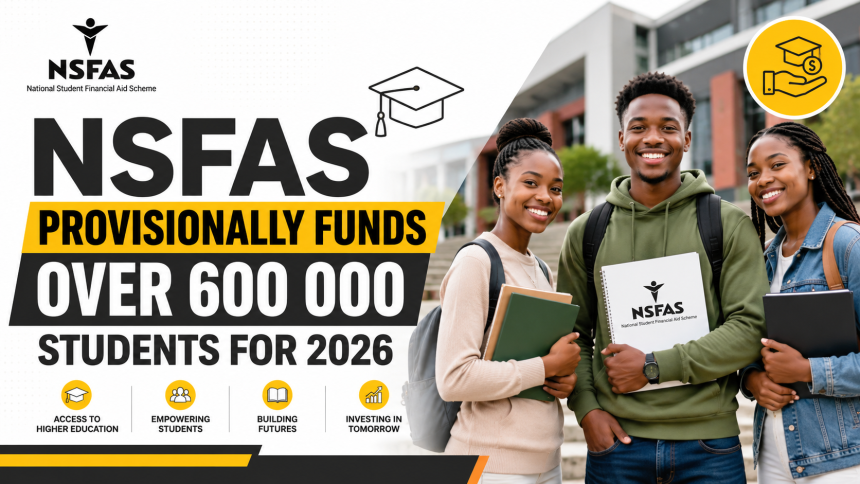
NSFAS Provisionally Funds Over 600 000 Students For 2026. The National Student Financial Aid Scheme (NSFAS) has taken a significant step forward in ensuring accessible higher education for South African students.
For the 2026 academic year, NSFAS has provisionally approved funding for more than 600,000 students. However, final confirmation will depend on further verifications to ensure compliance with all funding requirements.
NSFAS Provisionally Funds Over 600 000 Students For 2026
During a recent National Council of Provinces Committee (NCOP) Education, Sciences and Creative Industries meeting, it was revealed that NSFAS had received an overwhelming 890,000 bursary applications for the 2026 academic year. Additionally, 17,369 applications for student loans were submitted.

Out of these applications, 607,564 students have been provisionally approved for funding. However, they will only start benefiting once their institutions submit their registration data to NSFAS for final validation. Currently, 243,690 applicants have already had their registrations confirmed and are fully funded.
Comprehensive NSFAS Funding Support

NSFAS provides a comprehensive financial aid package, covering essential expenses such as:
- Tuition and registration fees
- Accommodation costs
- Food allowances
- Learning materials and stationery
This extensive support ensures that financially disadvantaged students have the opportunity to pursue higher education without financial constraints.
Rejections and Appeals: Numbers Behind NSFAS Decisions
While many students have been provisionally funded, not all applications were successful. NSFAS confirmed that 97,375 applications were rejected as they did not meet the funding criteria. However, 75,294 students have submitted appeals, hoping for reconsideration.
The scheme also highlighted that 733,403 applicants were South African Social Security Agency (SASSA) grant beneficiaries, with 703,615 receiving automatic funding approvals due to their financial eligibility. Nevertheless, 14,291 SASSA beneficiary applications were cancelled, and 12,746 applications were rejected for failing to meet academic criteria.
Verification Bottlenecks for Non-SASSA Applicants
For students who are not SASSA beneficiaries, the financial eligibility process is more rigorous. To qualify for an NSFAS bursary, applicants must come from households earning less than R350,000 per year. As a result, 146,961 non-SASSA applicants have been provisionally approved for 2026 funding. Meanwhile, 287,977 non-SASSA applications remain under review for verification purposes.
One of the significant challenges in the funding process is the requirement for additional documentation. At least 28,345 non-SASSA applicants must submit further documents to prove their financial eligibility, causing delays in final approvals.

Conclusion
The provisional funding approval is a crucial first step, but students must ensure their institutions submit their registration data promptly. Additionally, those required to provide further documentation should act swiftly to avoid delays in receiving financial aid.