
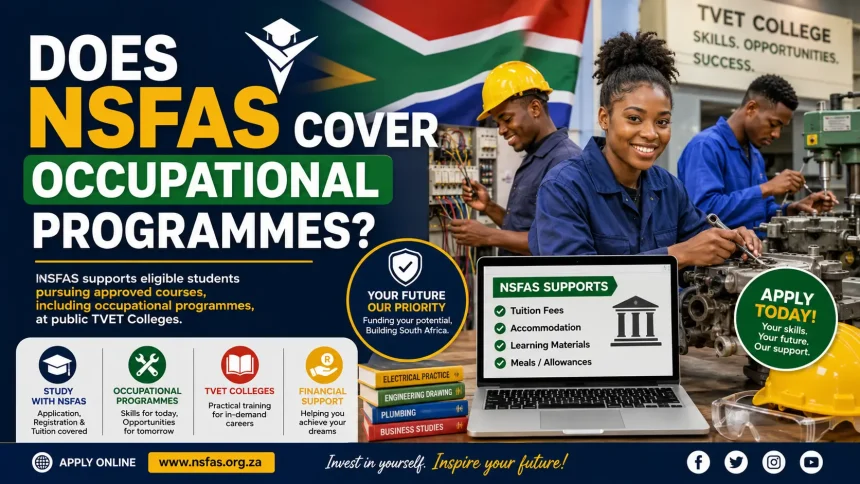
NSFAS Cover Occupational Programmes. The National Student Financial Aid Scheme (NSFAS) plays a vital role in helping thousands of South African students access higher education each year. While many students know that NSFAS funds university degrees and TVET College qualifications, many are unsure whether Occupational Programmes are also covered.
The good news is that NSFAS does provide funding for eligible students enrolled in Occupational Programmes at public TVET Colleges. However, the funding structure differs slightly from the support offered to students studying other qualifications.
This guide explains everything you need to know about NSFAS funding for Occupational Programmes in 2026, including eligibility requirements, what expenses are covered, and important application dates.

What Is NSFAS?
The National Student Financial Aid Scheme (NSFAS) is a South African government-funded financial aid programme that helps students from low-income households pursue higher education without the burden of high education costs.

Eligible students studying at South Africa’s 26 public universities and 50 public TVET Colleges can receive NSFAS funding to cover various study-related expenses.
NSFAS funding generally includes:
- Tuition fees
- Registration fees
- Student accommodation (where applicable)
- Transport allowance
- Learning materials
- Personal care and living allowances

These benefits enable students to focus on completing their qualifications instead of worrying about financial challenges.
What Are Occupational Programmes?
Occupational Programmes are practical, career-focused training courses offered at public TVET Colleges across South Africa.
Unlike traditional academic programmes, Occupational Programmes emphasize hands-on learning and workplace experience. They prepare students with the practical skills needed for specific industries, trades, and professions, making graduates job-ready upon completion.
These programmes are gradually replacing the older NATED (N1–N4) qualifications, which are currently being phased out. While students already enrolled in NATED programmes can complete their studies, new admissions are increasingly being directed toward Occupational Programmes.

Occupational Programmes are ideal for students who prefer learning through practical experience rather than classroom-based theory.
Does NSFAS Fund Occupational Programmes?
Yes. NSFAS has confirmed that eligible students enrolled in Occupational Programmes at public TVET Colleges can receive financial assistance.
However, funding for Occupational Programmes operates differently from funding provided for other TVET or university qualifications.
For qualifying students, NSFAS generally pays the full tuition fees required for the Occupational Programme.
In addition to tuition, certain students may also qualify for allowances depending on the nature of their training.
What Does NSFAS Cover?
Students studying Occupational Programmes may receive funding for:
- Full tuition fees
- Accommodation allowance (where applicable)
- Transport allowance
- Learning materials
- Personal care allowance
However, these additional allowances are generally provided only when students participate in simulated training, where practical learning takes place in a training environment instead of a workplace with an employment contract.
Who Qualifies for NSFAS Occupational Programme Funding?
To qualify for NSFAS funding, applicants must meet several eligibility requirements.
You must:
- Be a South African citizen.
- Be registered or accepted into an Occupational Programme at one of South Africa’s public TVET Colleges.
- Demonstrate financial need.
- Have a combined household income of R350,000 or less per year.
Meeting these requirements does not automatically guarantee funding, but it is essential for your application to be considered.
When Are Students Not Eligible for NSFAS Allowances?
While many Occupational Programme students qualify for tuition funding and allowances, there are exceptions.
Students who are employed under an official employment contract and receive a monthly stipend while completing their Occupational Programme are generally not eligible for NSFAS allowances.
This is because their employer already provides financial support during the workplace-based learning component.
Although these students may still receive tuition funding if eligible, accommodation, transport, and personal allowances are usually not provided.
Why Occupational Programmes Are Becoming More Popular
Occupational Programmes have become increasingly popular because they offer direct pathways into employment.
Many industries in South Africa require skilled workers who have practical experience rather than only theoretical knowledge. These programmes combine classroom instruction with workplace training, allowing graduates to develop the skills employers are actively seeking.
Students completing Occupational Programmes often find opportunities in sectors such as engineering, construction, manufacturing, hospitality, information technology, business services, and many other technical fields.
NSFAS Applications for Second Semester Occupational Programmes 2026
NSFAS has officially announced the application period for second-semester Occupational Programme funding at public TVET Colleges.
The application window is:
- Opening Date: 1 July 2026
- Closing Date: 17 July 2026
Students interested in receiving NSFAS funding should submit their applications before the closing date, as late applications may not be considered.
Applicants are encouraged to prepare all required supporting documents early to avoid delays during the application process.
Conclusion
NSFAS continues to expand access to quality education by supporting students enrolled in Occupational Programmes at public TVET Colleges. Eligible students can receive funding for tuition and, in many cases, additional allowances that help cover accommodation, transport, learning materials, and other study-related expenses.
However, students receiving a workplace stipend through an employment contract should remember that they may not qualify for these extra allowances.
If you plan to begin an Occupational Programme during the second semester of 2026, make sure you meet the eligibility requirements and submit your NSFAS application between 1 July 2026 and 17 July 2026 to avoid missing this important funding opportunity.