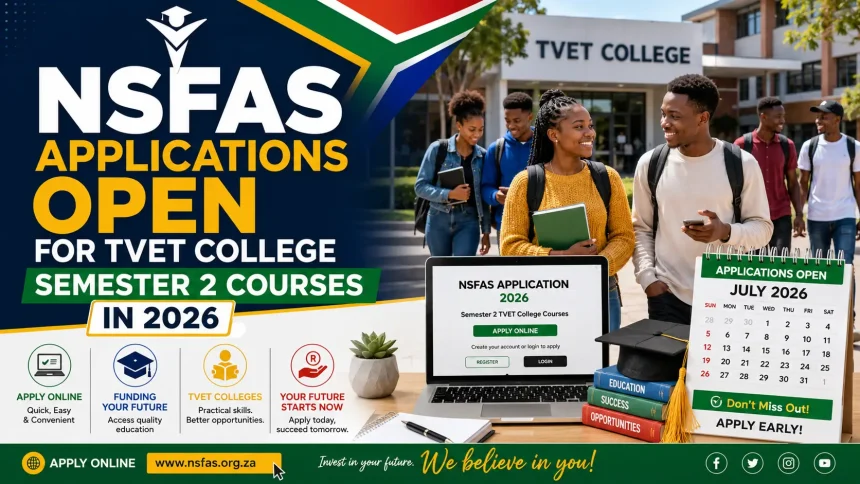
NSFAS Applications Open for TVET College. The National Student Financial Aid Scheme (NSFAS) has officially opened a new application window for eligible students who want to study at Technical and Vocational Education and Training (TVET) Colleges in South Africa. However, this application period is only available for selected Semester 2 TVET courses and the second intake of Occupational Qualifications (OQ2).
Students planning to continue their education through a public TVET College should submit their applications before the deadline. It is important to understand that this funding window does not apply to university students or 2027 university programmes.
NSFAS Opens Limited Funding Window
NSFAS provides financial assistance to qualifying South African students who wish to study at public universities and public TVET Colleges. The scheme covers eligible students with funding that helps pay for tuition and other approved study-related expenses.

The current application period is specifically designed for students enrolling in:
- Semester 2 TVET College programmes
- Occupational Qualifications (OQ2) second intake

Students applying for any other programmes should wait until the relevant application window opens.
Who Can Apply?
This application round is intended for students who plan to register for eligible Semester 2 courses at public TVET Colleges across South Africa.

TVET Colleges offer a wide range of practical and career-focused programmes in fields such as:
- Engineering Studies
- Business Studies
- Information Technology
- Hospitality and Tourism
- Agriculture
- Construction
- Health and Community Services
- Occupational Qualifications
These programmes are designed to equip students with practical skills that improve employment opportunities and prepare them for various industries.
University Applications Are Not Yet Open
Students who want to study at a public university in 2027 should note that university NSFAS applications have not yet opened.
Historically, NSFAS opens applications for university funding between September and October each year. The official dates for the 2027 application cycle have not yet been announced.

Prospective university students are encouraged to monitor official NSFAS announcements so they do not miss future application deadlines.
NSFAS Uses a Student-Centred Application System
NSFAS has reminded applicants that every student must submit their own funding application.
Under the student-centred funding model:
- Each applicant is responsible for creating their own account.
- Students must complete the application themselves.
- Colleges and universities do not submit NSFAS applications on behalf of students.
- Funding decisions are made directly by NSFAS after reviewing each application.
This system gives applicants direct control over their funding application and allows them to track its progress online.
Create a Profile Is Not Enough
One of the most common mistakes made by applicants is assuming that creating an NSFAS profile automatically counts as a funding application.
NSFAS has clearly stated that:
- Registering an account is only the first step.
- Students must complete every section of the application form.
- The application must be submitted successfully before the closing date.
- An incomplete application will not be considered for funding.
Applicants should carefully review their information before submitting to avoid unnecessary delays.
Submit Supporting Documents If Requested
Most NSFAS applications require only limited documentation. However, in some cases applicants may be asked to provide supporting documents.
If additional documents are requested, students should upload them directly through the official NSFAS online portal.
Examples of supporting documents may include:
- Certified identity documents
- Proof of income (where applicable)
- Consent forms
- Other verification documents requested by NSFAS
Uploading clear and accurate documents can help speed up the assessment process.
Apply Through the Official NSFAS Website
Students are advised to complete their applications only through the official NSFAS online portal.
Avoid using unofficial websites or third-party services that claim to process NSFAS applications for a fee. Applying directly through the official platform helps protect your personal information and ensures your application reaches NSFAS securely.
After submitting an application, students should regularly log into their NSFAS account to monitor their application status and respond promptly if additional information is requested.
Choose the Correct Programme
Applicants should ensure they apply for funding that matches the programme they intend to study.
Since the current funding window only covers Semester 2 TVET courses and Occupational Qualifications (OQ2), students applying for university programmes or other intakes may not qualify during this application period.
Choosing the correct programme helps avoid delays or unsuccessful applications.
Contact Your Nearest TVET College
Students who are unsure which courses are available should contact their nearest public TVET College.
College admissions offices can provide information about:
- Available Semester 2 programmes
- Occupational Qualification courses
- Entry requirements
- Registration dates
- Course duration
Obtaining accurate information before applying can help students select the most suitable programme for their career goals.
Conclusion
The opening of the NSFAS Semester 2 application window provides another valuable opportunity for eligible South African students to continue their education through public TVET Colleges. Since this funding round is limited to Semester 2 courses and Occupational Qualification programmes, applicants should ensure they meet the eligibility requirements and complete every step of the online application process. Students planning to attend university in 2027 should wait for the separate NSFAS university application period, which is expected to open later this year. Applying early, submitting accurate information, and monitoring your application status can greatly improve your chances of receiving NSFAS funding.