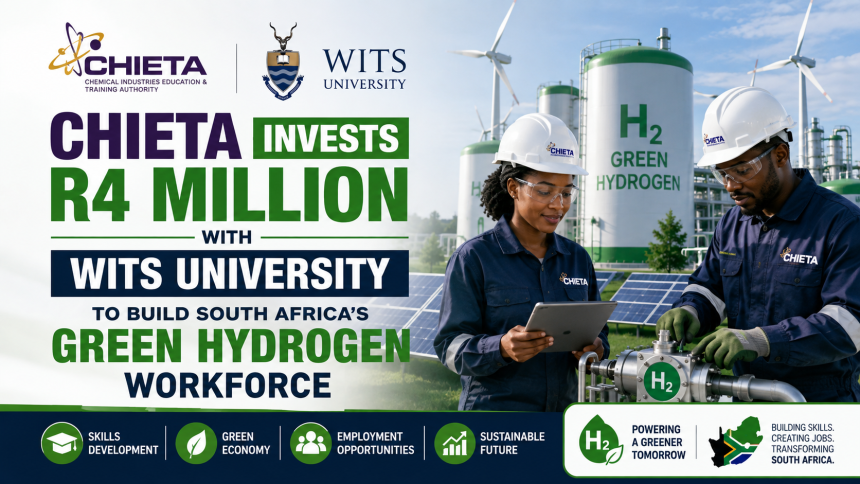
CHIETA Invests R4 Million with Wits. South Africa is taking another major step toward becoming a leader in the global green hydrogen economy. The Chemical Industries Education and Training Authority (CHIETA) has announced an investment of more than R4 million in partnership with the African Energy Leadership Centre (AELC) at Wits Business School, University of the Witwatersrand. This strategic initiative aims to strengthen research, develop highly skilled professionals, and prepare the country’s workforce for the growing green hydrogen sector.
As countries around the world accelerate their transition to cleaner energy sources, South Africa recognizes that success depends not only on technology and infrastructure but also on developing a workforce capable of driving innovation. Through this collaboration, CHIETA is investing in education, research, and entrepreneurship to ensure that South Africa remains competitive in the global clean energy market.
CHIETA R4 Million Investment
The partnership between CHIETA and Wits University will provide financial support for:

- One PhD candidate conducting advanced Green Hydrogen research.
- One Postdoctoral Fellow focusing on innovative clean energy solutions.
- A specialized short training course for 20 participants from chemical industry SMMEs, entrepreneurs, and startups.
The initiative is designed to build practical skills, promote research excellence, and encourage innovation across South Africa’s energy sector. By supporting both academic research and industry-focused training, CHIETA hopes to bridge the gap between education and employment.
Why Green Hydrogen Matters

Green hydrogen is rapidly emerging as one of the world’s most promising renewable energy sources. It is produced using renewable electricity to split water into hydrogen and oxygen, resulting in zero carbon emissions during production.
Unlike fossil fuels, green hydrogen can help reduce emissions in sectors that are difficult to electrify, including:
- Heavy transportation
- Agriculture
- Manufacturing
- Mining
- Chemical industries
- Industrial heating

Many countries are investing billions in hydrogen technologies as part of their climate commitments. South Africa, with its abundant renewable energy resources and mineral wealth, has the potential to become a leading producer and exporter of green hydrogen.
Building Skills for South Africa’s Energy Future
One of the biggest challenges facing South Africa’s energy transition is the shortage of skilled professionals. While the country has ambitious renewable energy goals, achieving them will require scientists, engineers, technicians, researchers, and entrepreneurs who understand emerging technologies.
South Africa’s Hydrogen Society Roadmap aims to produce approximately 500,000 tonnes of green hydrogen annually by 2030. Achieving this target will require significant investment in research institutions, technical education, and workforce development.
CHIETA believes that investing in people today will ensure the country has the expertise needed to support future industries.

Developing Future Leaders
According to CHIETA Chief Executive Officer Yershen Pillay, South Africa’s biggest challenge is not simply a shortage of skills but a shortage of experience.
He emphasized that future workers must become:
- Multi-skilled professionals
- Adaptable lifelong learners
- Digital technology specialists
- Innovation-driven entrepreneurs
- Problem solvers capable of creating new business opportunities
Pillay also highlighted the importance of integrating digital transformation, artificial intelligence, and data-driven learning into higher education curricula. Instead of preparing students only to find employment, educational institutions should empower graduates to become job creators and innovators.
This philosophy aligns perfectly with the demands of the rapidly evolving green hydrogen industry.
Partnership Between Education and Industry
The collaboration between CHIETA and the African Energy Leadership Centre combines academic excellence with practical industry knowledge.
Students and researchers will gain opportunities to work on real-world energy challenges while contributing to policy development and technological innovation. Entrepreneurs and SMMEs participating in the short course will also receive valuable training that can help them identify new business opportunities within South Africa’s clean energy sector.
This approach ensures that research findings are translated into practical solutions that benefit industries, communities, and the broader economy.
Supporting South Africa’s Just Energy Transition
The Green Hydrogen initiative also supports South Africa’s broader Just Energy Transition, which aims to reduce carbon emissions while ensuring economic growth and social inclusion.
Rather than replacing existing industries overnight, the transition focuses on creating new employment opportunities, developing future-ready skills, and supporting communities affected by changes in the energy sector.
Researchers at the African Energy Leadership Centre believe that meaningful collaboration between government, universities, and industry will be essential to achieving these goals.
Their work includes promoting sustainable energy systems, supporting evidence-based policy development, and addressing energy poverty across Africa.
Expanding Collaboration Across Africa and BRICS
The partnership extends beyond South Africa’s borders. CHIETA and Wits University hope to strengthen collaboration across the African continent and the BRICS nations.
By sharing research, expertise, and best practices, South Africa can position itself as a regional leader in green hydrogen innovation. International partnerships will also create opportunities for knowledge exchange, investment, and technological development that benefit the entire region.
Building on Previous Green Hydrogen Projects
This investment is not CHIETA’s first contribution to the green hydrogen sector.
Previously, the organization supported:
- A Green Hydrogen Centre of Specialisation in partnership with the Mining Qualifications Authority and the Transport Education Training Authority.
- An industry-integrated Green Hydrogen Fuel Cell Training System developed with Sasol at its Sasolburg operations.
The new partnership with Wits University expands these efforts by supporting advanced postgraduate research while continuing to develop industry-focused skills.
Long-Term Investment in South Africa
While many initiatives focus on short-term projects, CHIETA views this investment as part of a much larger vision for South Africa’s future.
The organization believes that sustainable economic growth depends on building human capital alongside technological innovation. By investing in education today, South Africa will be better prepared to compete in tomorrow’s global clean energy economy.
As the country continues its journey toward a low-carbon future, partnerships like this demonstrate the importance of connecting research, education, government, and industry. Developing skilled professionals, encouraging entrepreneurship, and supporting innovation will ensure that South Africa can fully capitalize on the opportunities presented by the green hydrogen revolution.
Conclusion
CHIETA R4 million investment in partnership with Wits University represents a significant milestone in South Africa’s clean energy journey. By funding doctoral research, postdoctoral innovation, and specialized industry training, the initiative is helping develop the workforce needed to support the country’s ambitious Green Hydrogen goals.
As global demand for renewable energy continues to grow, South Africa has the opportunity to become a leading player in the green hydrogen economy. Success, however, will depend on more than technology alone. Investing in people, education, research, and innovation will be the foundation of a sustainable and competitive energy future for generations to come.