
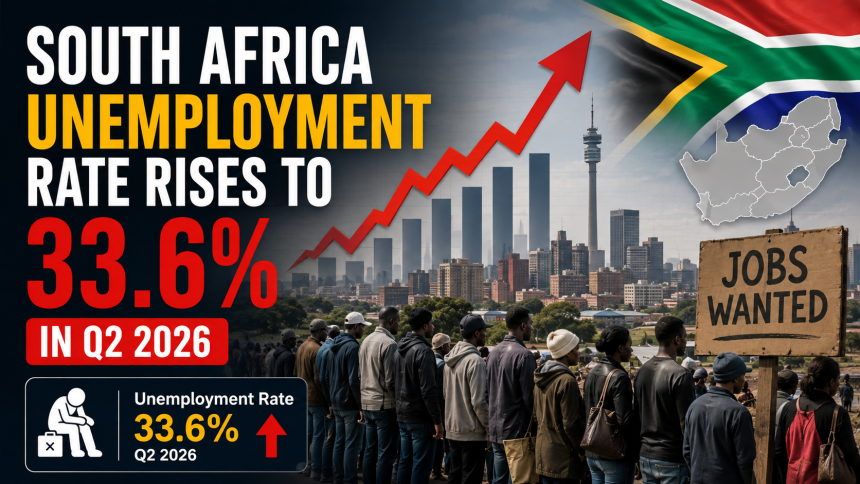
South Africa Unemployment Rate Rises. South Africa unemployment rate increased to 33.6% in the second quarter of 2026, highlighting continued pressure on the country’s labour market. According to the latest Quarterly Labour Force Survey released by Statistics South Africa (Stats SA), the official unemployment rate rose by 0.9 percentage points from 32.7% in the first quarter of 2026.
The latest figures show that unemployment increased even as overall employment declined slightly. The data also highlights the difficult employment conditions facing young South Africans, with the youth unemployment rate climbing to 47.4% during the quarter.
Number of Unemployed People Increases
Stats SA reported a significant increase in the number of unemployed people between the first and second quarters of 2026. The number of unemployed South Africans increased by 345,000 to 8.5 million.

At the same time, the number of employed people decreased by 16,000, falling to approximately 16.7 million. These changes resulted in an overall increase in the labour force of 329,000 people, representing growth of about 1.3% over the quarter.

The rise in unemployment demonstrates that the labour market is struggling to absorb the growing number of people who are looking for work. While some industries added jobs, losses in other sectors outweighed these gains.
Which Industries Created Jobs?
Despite the increase in the national unemployment rate, several industries recorded employment growth during the second quarter.

The trade sector recorded the largest increase, adding around 70,000 jobs. Construction also performed positively, with employment increasing by approximately 39,000.
The finance sector added a further 11,000 jobs, showing some resilience within parts of South Africa’s service economy.
However, several important industries experienced employment losses. Community and social services recorded the largest decline, with approximately 57,000 jobs lost. Mining employment fell by 26,000, while agriculture and manufacturing each recorded declines of around 15,000 jobs.
These contrasting trends demonstrate that employment opportunities remain uneven across the South African economy.

Formal and Informal Employment Trends
Employment changes also differed between the formal and informal sectors.
The number of people employed in the formal sector declined by 41,000 during the second quarter. Household employment also decreased, falling by approximately 9,000.
In contrast, informal-sector employment increased by 34,000. The growth in informal employment may indicate that some people are turning to informal economic activities when formal employment opportunities are limited.
Although informal work can provide an important source of income, it often does not offer the same level of employment security, benefits and protections associated with formal jobs.
Employment Changes Across Provinces
Employment trends varied significantly across South Africa’s provinces during the second quarter of 2026.
Mpumalanga recorded the largest employment increase, with approximately 41,000 additional jobs. The Eastern Cape added around 13,000 jobs, while the Free State recorded an increase of approximately 9,000.
However, several provinces experienced notable employment declines. The Western Cape recorded the largest decrease, losing around 48,000 jobs. Gauteng followed with a decline of approximately 22,000, while North West recorded a reduction of around 15,000 jobs.
These provincial differences demonstrate that employment conditions can vary considerably depending on regional economic activity and industry composition.
Decline in Discouraged Job-Seekers
The latest labour-force data also showed a decline in the number of discouraged job-seekers. Their number decreased by 227,000 to approximately 3.7 million during the second quarter.
Other available job-seekers declined by 49,000 to around 861,000, while unavailable job-seekers decreased by approximately 4,000 to 44,000.
As a result, the potential labour force declined by 280,000 to approximately 4.6 million.
The potential labour force includes people who are available for work but are not actively seeking employment, as well as people who are looking for work but are currently unavailable to start.
Meanwhile, the number of people outside the labour force for other reasons increased by 72,000 to approximately 12.5 million. Overall, the number of people outside the labour force declined by 208,000 to around 17.1 million.
Youth Unemployment Remains a Major Concern
One of the most concerning findings from the latest Quarterly Labour Force Survey is the continued deterioration in youth employment.
The number of unemployed young people aged 15 to 34 increased by 264,000 to 5 million during the second quarter of 2026. At the same time, youth employment declined by 40,000 to approximately 5.6 million.
Consequently, the youth unemployment rate increased by 1.5 percentage points to 47.4%.
The figure means that nearly half of young people within the relevant labour-force measure are unemployed. Persistent youth unemployment remains a major economic and social challenge because limited access to work can affect income, skills development, career progression and long-term economic participation.
What the Latest Figures Mean for South Africa
The increase in the overall unemployment rate to 33.6% reflects the difficult conditions facing South Africa’s labour market. Although certain industries, including trade and construction, created jobs, employment gains were not sufficient to offset losses in other sectors.
The decline in formal-sector employment is another important development, while the increase in informal employment suggests that some workers may be relying more heavily on alternative forms of economic activity.
The situation for young people is particularly challenging. With youth unemployment rising to 47.4%, expanding access to quality jobs, skills development, training and work experience remains essential for improving employment prospects.
Conclusion
South Africa’s unemployment rate rose from 32.7% to 33.6% in the second quarter of 2026, according to Stats SA. The number of unemployed people increased to 8.5 million, while total employment fell slightly to 16.7 million.
Although trade, construction and finance recorded employment gains, job losses in community and social services, mining, agriculture and manufacturing contributed to the overall deterioration.