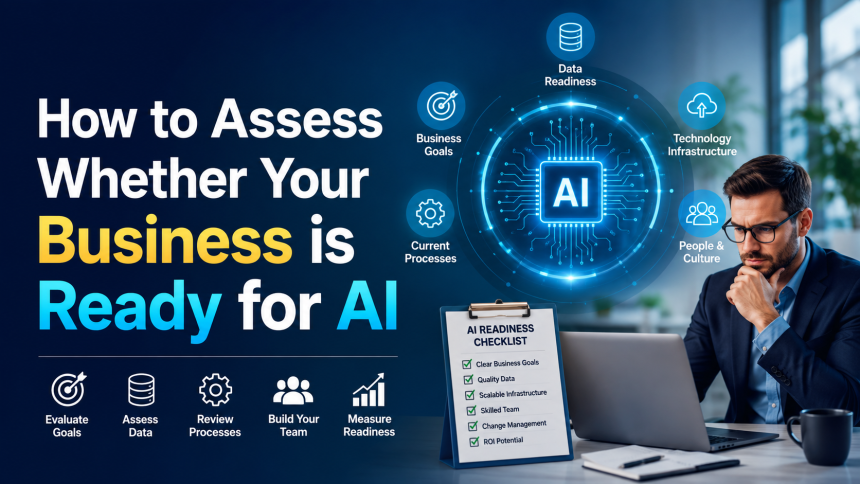
Whether Your Business is Ready for AI. Artificial intelligence is quickly becoming an important part of modern business. From automating repetitive tasks to improving productivity, analysing information, and supporting employees, AI can create significant opportunities for organisations of all sizes. However, simply purchasing an AI tool does not mean a business is ready to use it successfully.
Before investing heavily in AI, businesses should assess their current technology, data, security, workforce, and overall strategy. An AI readiness assessment can help leaders understand what is already in place, identify gaps, and determine which areas should be addressed before expanding AI adoption.
Start by Identifying a Clear Business Goal
The first step in assessing AI readiness is to understand why the organisation wants to use AI. Saying that a company “needs AI” is not enough to create a useful implementation strategy.

Instead, businesses should identify a specific problem or process that could benefit from AI. This could include reducing administrative work, improving customer service, helping employees find information faster, analysing documents, or automating repetitive activities.

A suitable first use case should have a clear owner, measurable challenges, and an identifiable business outcome. Starting with a focused project allows the organisation to test AI in a controlled environment before considering a wider rollout.
Evaluate the Quality of Your Data
Data is one of the most important foundations of any successful AI strategy. AI tools depend on the information available to them, which means inaccurate, outdated, duplicated, or poorly organised information can reduce their usefulness.

Businesses should identify where important information is stored and determine who is responsible for managing it. They should also check whether employees have appropriate access to business information.
For organisations using Microsoft 365, this can include reviewing information stored across SharePoint, OneDrive, Exchange, and other connected systems. Existing permissions and sharing settings remain important because AI systems operate within the access rights already established in the organisation.
Before introducing AI, businesses should ask whether their information is accurate, accessible to authorised employees, properly organised, and regularly maintained.
Review Security and Governance
AI adoption also requires strong governance. Businesses need clear rules explaining how AI tools can be used, what information employees are allowed to enter, and when human review is necessary.

Leadership should establish responsibility for approving AI tools and monitoring their use. Employees should understand which applications are authorised and how sensitive or confidential information must be handled.
Security should also include reviewing existing access permissions and identifying overshared information. Organisations should consider privacy requirements and applicable regulations when AI processes personal or confidential information.
Good governance does not have to make AI complicated. Instead, it should provide employees with practical guidance while giving management appropriate oversight.
Check Your Technology Infrastructure
A business may have a strong AI idea but still lack the technical foundation needed to support it effectively.
AI readiness can depend on identity management, cybersecurity, software configuration, licensing, integration capabilities, devices, connectivity, and internal IT support.
Businesses should review their existing technology environment before beginning a major deployment. They should determine whether their systems can support the intended AI tools and whether security controls are properly configured.
It is also important to understand that AI cannot automatically solve underlying technology problems. Poor permissions, outdated systems, or weak security practices should be addressed as part of the preparation process.
Prepare Employees for AI Adoption
Technology alone cannot make an AI project successful. Employees need to understand how AI will affect their daily responsibilities and where it can provide genuine value.
Businesses should provide practical training based on employees’ roles. For example, sales teams may need guidance on using AI for customer information and communication, while administrative teams may benefit from AI for document creation, summarisation, and repetitive tasks.
Employees should also understand the limitations of AI. AI-generated information may require verification, particularly when decisions involve customers, finances, legal matters, or other sensitive areas.
Managers have an important role in encouraging responsible adoption. They should give employees opportunities to experiment, collect feedback, and identify workflows where AI can provide measurable benefits.
Measure the Results
A successful AI strategy should be based on measurable outcomes rather than simply counting how many employees have access to an AI tool.
Before launching an AI project, businesses should decide how success will be measured. Depending on the use case, this could involve turnaround times, employee productivity, reduced repetitive work, improved customer response times, or better access to information.
Establishing measurements before implementation provides a baseline for comparison. It also helps leaders determine whether an AI investment is delivering genuine business value.
AI adoption should therefore be treated as an ongoing process rather than a one-time technology purchase. Businesses should continue reviewing employee feedback, performance data, security requirements, and changing business needs.
Assess the Organisation Across Multiple Areas
A comprehensive AI readiness assessment should look beyond technology. Microsoft’s AI readiness approach, for example, considers areas such as business strategy, governance and security, data foundations, organisational culture, infrastructure, AI experience, and model management.
These areas are connected. A company may have excellent technology but poor data governance. Another organisation may have strong data but employees who have not been trained to use AI effectively.
Looking at multiple areas provides a more realistic picture of organisational readiness and helps businesses prioritise improvements.
Create a Practical AI Roadmap
Once the assessment is complete, the next step is to create a practical roadmap. Not every weakness needs to be fixed before a business can experiment with AI, but important risks and limitations should be addressed before wider deployment.
The roadmap should identify immediate priorities, suitable pilot projects, employee training requirements, security improvements, and longer-term AI opportunities.
A phased approach can often be more effective than attempting to introduce AI across the entire organisation at once. Businesses can begin with a carefully selected use case, measure the results, learn from the experience, and gradually expand successful initiatives.
Conclusion
Determining whether a business is ready for AI requires more than choosing an AI application or purchasing new licences. Organisations need to examine their goals, data, security, governance, technology infrastructure, workforce, and ability to measure results.
A well-planned AI readiness assessment can reveal both opportunities and gaps. It allows business leaders to make informed investment decisions and build an AI strategy based on real business requirements rather than market pressure.